

There’s a specific week in every transaction that owners remember afterward. The letter of intent is signed, everyone shook hands, and then a document arrives from the buyer’s advisors with about two hundred numbered requests on it.
That’s the start of EAP due diligence, and it is the phase where more employee assistance program (EAP) deals lose value than any other. Not because businesses turn out to be bad. Because businesses turn out to be undocumented, and undocumented gets priced the same way as bad.
This is what the process covers, what gets asked for in this sector specifically, where it typically goes wrong, and how to arrive with the answers already assembled.
What EAP due diligence actually is
EAP due diligence is the buyer’s verification process: the work of confirming that the business they agreed to buy is the business that exists. It runs from the signed letter of intent to closing, typically three to five months, and it is conducted by the buyer’s accountants, lawyers, and often a commercial or clinical specialist.
Two things are worth understanding about the dynamic before you’re in it.
You are in exclusivity. You agreed not to talk to other buyers. That was the price of the offer, and it means every issue found during EAP due diligence is negotiated with one party who knows you have no alternative. This is not sharp practice; it’s just structure. But it explains why preparation matters so much more than negotiation skill.
The buyer’s team is paid to find problems. A quality-of-earnings provider who reports “everything was fine” has not demonstrated value. Expect thoroughness, expect challenge, and don’t read either as bad faith.
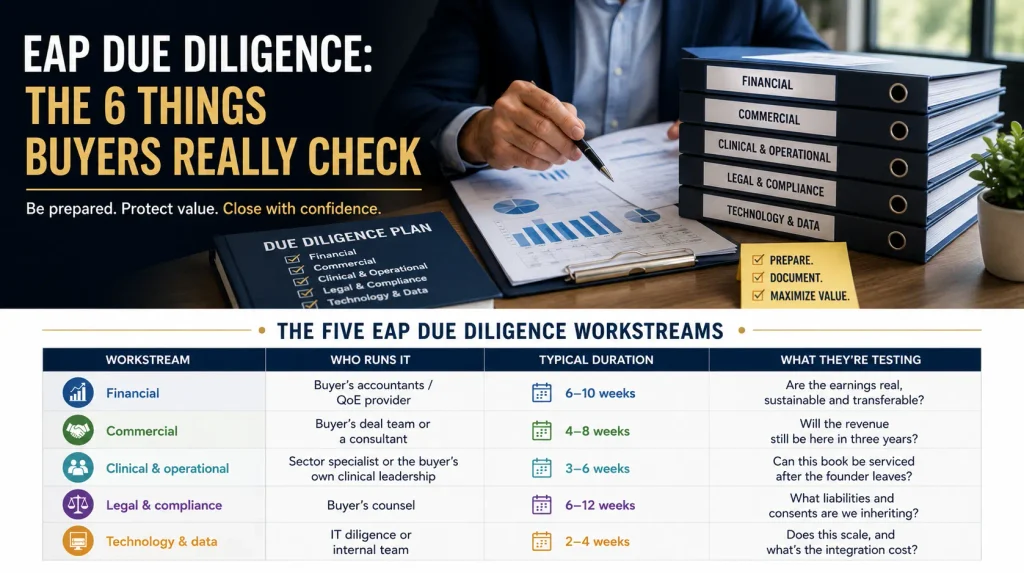
The five EAP due diligence workstreams
| Workstream | Who runs it | Typical duration | What they’re testing |
|---|---|---|---|
| Financial | Buyer’s accountants / QoE provider | 6–10 weeks | Are the earnings real, sustainable and transferable? |
| Commercial | Buyer’s deal team or a consultant | 4–8 weeks | Will the revenue still be here in three years? |
| Clinical & operational | Sector specialist or the buyer’s own clinical leadership | 3–6 weeks | Can this book be serviced after the founder leaves? |
| Legal & compliance | Buyer’s counsel | 6–12 weeks | What liabilities and consents are we inheriting? |
| Technology & data | IT diligence or internal team | 2–4 weeks | Does this scale, and what’s the integration cost? |
Illustrative framework — not transaction guidance.
They run concurrently, not in sequence, which is why the phase feels like being audited by five organizations at once. It is.
The sequencing detail that matters: financial and legal start immediately and run longest, so the documents those two workstreams need are the ones to have ready on day one. Clinical and technology diligence tend to start a few weeks in, which buys you a little time — but only a little, and only if you know it’s coming.
The six things buyers really check
Out of two hundred requests, six carry most of the weight.
1. Whether adjusted EBITDA survives contact
The quality-of-earnings review is the centerpiece of financial EAP due diligence, and it does three things: tests whether your revenue is recognized in the right period, whether your add-backs are genuine, and whether the earnings would persist under new ownership.
Revenue recognition is the sector-specific trap. EAP contracts are annual and often billed in advance, so cash-basis books make earnings look lumpy for reasons that have nothing to do with performance. The QoE provider will restate to accrual. If you’ve already done it, this is a confirmation exercise. If you haven’t, it’s a discovery exercise, and discoveries during exclusivity have a habit of moving the price.
Add-backs get tested one at a time against evidence. The valuation pillar sets out which ones typically survive.
2. The contract file, line by line
Every employer agreement gets read. Not skimmed — read, by a lawyer, with a checklist.
They are pulling out: remaining term, renewal mechanic, notice periods, termination-for-convenience rights, price escalators, service-level commitments, indemnities, data-handling obligations, and above all change-of-control and assignment provisions.
That last item can reshape the entire deal. If your major contracts require the employer’s consent to continue after a sale, the buyer either restructures the transaction to avoid triggering them, holds back part of the price, or conditions an earnout on those contracts surviving. Pillar 4 explains the mechanics.
An owner who arrives with a contract matrix already built — every agreement, its term, its renewal mechanic, its consent language — removes weeks from this workstream and a great deal of anxiety from their own life.
3. Renewal and retention history, evidenced
Commercial EAP due diligence lives or dies on this one.
Not your stated retention rate. The one that can be reconstructed from contract records, by year and by employer size band, with losses identified.
Where the evidence doesn’t exist, the buyer models conservatively. That conservative number then feeds their forecast, which feeds their valuation, which is why “we’ve never really lost anyone” is an expensive sentence in a management meeting.
4. Concentration, and what happens if the big client leaves
Concentration analysis is one of the first things any EAP due diligence team builds, and they will do it themselves rather than take your version. Expect top-client and top-five revenue share across three years, with the trend called out.
Then they will want to understand the relationship: who holds it, how long it’s run, when it renews, what the procurement process looks like, and whether anyone other than you has a relationship with the decision-maker. If the honest answer to that last question is no, expect the structure to reflect it.
5. Clinical capability and licensure coverage
This is where a specialist buyer separates from a generalist, and where EAP due diligence looks nothing like diligence on a normal services business.
They’ll ask for the affiliate network roster by specialty and geography, credentialing files and their currency, licensure coverage by state or jurisdiction against your contracted employer footprint, time-to-fill for new affiliates, case-placement data showing in-network versus out-of-network referral rates, and clinical quality or outcomes reporting where it exists.
The question underneath all of it is simple: can this book be serviced next year by people who aren’t leaving with the seller?
There’s usually a related legal thread here too. EAP businesses commonly deliver through contracted affiliates rather than employees, and worker-classification exposure is a live diligence topic in services businesses generally. Know your position before it’s asked rather than after.
6. Utilization economics by contract
This is the request that most often exposes how well an owner knows their own book.
Blended utilization tells them nothing. They want it per employer, over three years, with case mix and cost per case.
What they’re testing is whether your pricing is sustainable — whether the contracts you’ve presented as profitable actually are, once delivery cost is allocated properly. Contracts running well below the pricing assumption go on their renewal-risk list. Contracts running well above go on their repricing list. Both change the forecast.
If you’ve never built a contract-level view, this is the request that hurts, because it’s assembled under time pressure by people who don’t know your business. The utilization piece covers how to build it beforehand.
What generalist advisors miss in EAP due diligence
Worth knowing, because it affects who you hire.
Generalist healthcare M&A diligence is built around reimbursement: payer mix, claims denial rates, rate compression, credentialing with insurers. Almost none of that applies to an employer-paid EAP. An advisor working from that playbook will spend weeks on the wrong risks and miss the ones that matter.
The four that get missed most often:
- Change-of-control language in employer contracts. Treated as boilerplate by people who haven’t seen it reshape a deal.
- The gap between utilization and pricing. A generalist reads low utilization as good margin. A specialist reads it as renewal risk.
- Affiliate network density as a cost driver. Thin coverage means out-of-network referrals at market rates. That’s a margin story hiding in an operations file.
- Deferred revenue in the working capital calculation. Annual contracts billed in advance mean you may be holding cash for services not yet delivered. How that’s treated at completion moves real money, and it’s negotiated in a schedule most sellers never read.
Private equity buyers in this sector generally do know all four — Stone Point Capital, for instance, has held ComPsych since 2017 (Stone Point Capital, accessed August 2026), and sponsors with sector history run diligence accordingly. Assume the buyer’s team understands your business. Make sure yours does too.
Who you need on your side of the table
Owners often assume their long-standing accountant and their commercial lawyer will cover this. Sometimes that’s right. More often it isn’t, and finding out in week three is expensive.
Your accountant needs transaction experience, not just competence. Producing accurate annual accounts and defending adjusted EBITDA against a quality-of-earnings provider are different skills. If your accountant has never sat opposite a QoE team, they will be learning the vocabulary while representing you in it.
Your lawyer needs healthcare M&A experience specifically. A good commercial solicitor can draft a share purchase agreement. Whether they will spot that your employer contracts’ change-of-control language interacts with the deal structure, or know how licensure and clinician classification are usually treated in this sector, is a different question. Ask directly how many behavioral health or contracted-services transactions they’ve closed.
Someone needs to own the request list day to day. EAP due diligence generates hundreds of individual items, and the single most common cause of delay is that responses queue behind an owner who is also running the company. Whether that’s a finance lead, an operations deputy or an advisor, name the person before diligence starts.
And you need someone whose job is to say no. In a process where you’re inside exclusivity and increasingly invested, having one person in the room whose role is to push back on scope creep, unreasonable requests and quiet renegotiation is worth a great deal. It’s difficult to be that person about your own business.
The general test: if the buyer’s team has done forty of these and your team has done one, the imbalance shows up in EAP due diligence as delay, and delay shows up in the final documents as price.
Six ways EAP due diligence goes wrong
1. The books get restated downward. Cash-basis accounting, unsupported add-backs, or revenue recognized in the wrong period. Fixable a year in advance, expensive to fix during exclusivity.
2. A major contract lapses or shortens mid-process. Renewals during diligence are watched intensely. A large client moving to a short-term extension in month three changes the shape of the deal. Sequence big renewals ahead of a process where you can.
3. Requests take too long to answer. Delay reads as disorganization at best and concealment at worst. It also extends exclusivity, which only helps the buyer.
4. The story changes. Something said in a management meeting turns out not to match the file. Even a small inconsistency triggers re-examination of everything else, and re-examination costs weeks.
5. Something material surfaces that the seller knew about. A disputed contract, a pending claim, a key affiliate resigning. Disclosed upfront, these are manageable. Discovered in month four, they are leverage.
6. The owner burns out. This is the underrated one. Diligence is four months of intense work on top of running the business, usually while keeping the whole thing confidential from most of the team. Owners who haven’t prepared spend it in permanent catch-up, make worse decisions, and start wanting the process over more than they want it done well. Buyers can tell.
Building the EAP due diligence data room
Start it during exit planning, not after the letter of intent.
The structure that works:
- 01 Corporate — formation documents, cap table, board minutes, licenses
- 02 Financial — three years accrual financials, general ledger, add-back schedule with supporting invoices, monthly management accounts, deferred revenue schedule
- 03 Contracts — every employer agreement, plus the contract matrix summarizing term, renewal, escalators and change-of-control language
- 04 Revenue & retention — revenue by client by year, renewal history by size band, pipeline, churn with reasons
- 05 Clinical & network — affiliate roster, credentialing files, licensure coverage map, case placement data, quality reporting
- 06 Utilization — utilization, case mix and cost per case by contract, three years
- 07 People — census, compensation, contractor agreements, classification position, key-person arrangements
- 08 Compliance & data — privacy policies, incident log, insurance, accreditation, cross-border data handling
- 09 Technology — systems inventory, platform ownership, integrations, reporting capability, roadmap and known gaps
Nine folders. Most of it can be assembled quietly over a year, in evenings, without anyone knowing why.
Owners who arrive at EAP due diligence with that already built don’t just close faster. They close on better terms, because a buyer who can verify everything quickly has fewer reasons to hold money back. The complete guide to selling an EAP business places this in the full sequence, and sell-side specialists including Olympic M&A will walk owners through the data room structure long before a process begins.
Frequently asked questions
What is EAP due diligence?
EAP due diligence is the buyer’s verification process between signing a letter of intent and closing, typically lasting three to five months. It covers financial, commercial, clinical and operational, legal and compliance, and technology workstreams, running concurrently and conducted by the buyer’s advisors.
How long does EAP due diligence take?
Three to five months is typical for a prepared business. Financial diligence runs six to ten weeks, legal six to twelve, clinical three to six, and technology two to four, all concurrently. Businesses on cash-basis accounting or with disorganized contract files take considerably longer.
What do buyers ask for during EAP due diligence?
Three years of accrual financials with general ledger detail, every employer contract, renewal history by size band, client concentration analysis, affiliate network rosters and credentialing files, licensure coverage by jurisdiction, utilization and cost per case by contract, employee census with contractor classification, and technology documentation.
What is a quality of earnings review?
A quality of earnings review is an independent analysis testing whether reported earnings are accurate, sustainable and transferable to a new owner. For EAP businesses it typically focuses on revenue recognition across annually contracted income, the validity of add-backs, and normalization of owner compensation.
Should I get a sell-side quality of earnings review?
For businesses of sufficient scale, generally yes. Finding your own accounting issues before a buyer does is far cheaper than having them discovered during exclusivity, when you have no alternative buyer and every finding becomes a negotiation you conduct from a weak position.
What is a data room?
A data room is the organized, access-controlled repository of documents a buyer reviews during due diligence. Building it during exit planning rather than after a letter of intent shortens the process, reduces price holdbacks and substantially lowers the operational burden on the owner.