
Someone has probably already given you a number.
Maybe it was a broker at a conference who asked about your revenue and then said “so you’re looking at” and named a figure. Maybe it was a buyer who called out of the blue and mentioned what they’d “typically pay.” Maybe it was a peer who sold two years ago and now quotes his multiple the way other men quote their golf handicap.
Whatever the source, that number is now sitting in your head, and it is doing damage. Not because it is too high or too low. Because it was produced without anyone looking at your contract file, and a valuation without a contract file is a guess wearing a suit.
So let’s do this properly. This is how EAP company worth valuation actually works, what an employee assistance program (EAP) company is worth, and the seven things that decide whether your business lands at the top or the bottom of whatever range applies to it.
The honest answer
There isn’t a number I can give you on a web page.
I know that’s an unsatisfying place to start. But any adviser who tells you what your EAP company is worth before seeing your renewal history, your client concentration and your normalized earnings is not doing an EAP company valuation. They are trying to get a meeting.
What I can do is show you the machinery. Because here’s the thing about EAP company valuation: it’s not mysterious. It’s arithmetic plus judgement, and the judgement part follows rules you can learn in an afternoon. Once you know the rules, you can look at your own business and see roughly where it sits — and, more usefully, see the two or three things that would move it.
That is worth more than a number anyway. A number tells you where you are. The rules tell you what to do.
There’s a reason I’m being pedantic about this. An EAP company valuation is not something a person hands you. It’s a conclusion you reach from evidence, and almost all of the evidence is already sitting in your own filing cabinet.
What actually gets multiplied
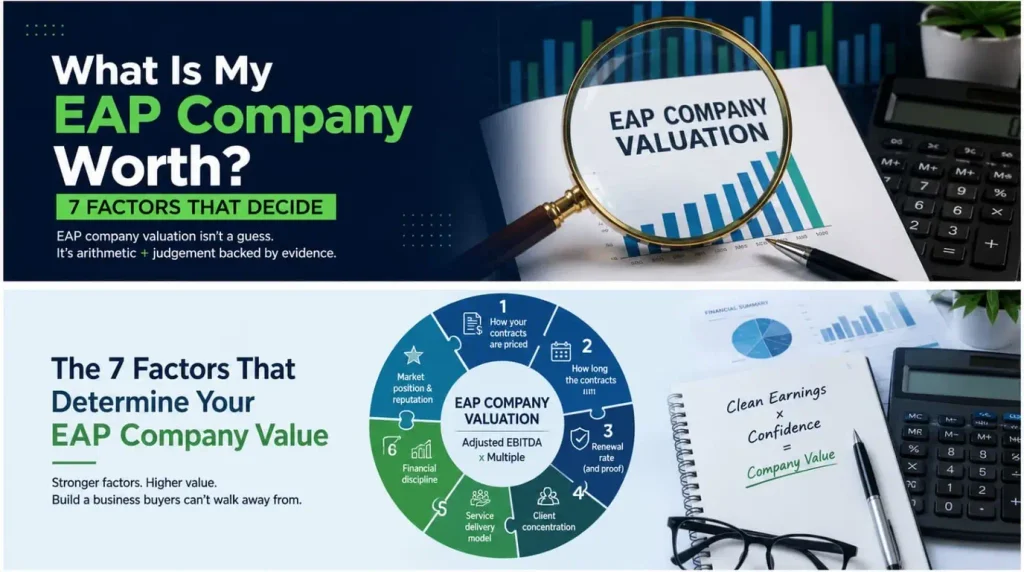
EAP company valuation is adjusted EBITDA times a multiple.
Not revenue. This trips up more owners than anything else, and it trips them up because revenue is the number they know by heart. A $6 million book sounds like a bigger business than a $3 million one, and it is. But if the $6 million book runs at a 9% margin and the $3 million book runs at 22%, they may not be worth wildly different money.
Adjusted EBITDA is your earnings before interest, tax, depreciation and amortisation, restated to show what the business would earn under someone else. That means normalizing your salary to what a hired manager would cost, stripping out genuinely one-off expenses, and — this one is specific to us — fixing revenue recognition on annually contracted PEPM income so it lands in the month it was earned rather than the month you invoiced it.
If you’re on cash-basis accounting, that last adjustment alone can change what your monthly earnings look like. Not because the business changed. Because the billing cycle was making the numbers dance.
The multiple is what a buyer pays per dollar of those earnings. It’s set by how confident they are that the earnings will still be there in three years without you.
That’s the whole EAP company valuation model. Two variables. And of the two, the one owners underestimate is the first, because that’s where sloppy books quietly cost real money before the multiple conversation even starts.
We go through the add-back mechanics in detail on the EAP business valuation pillar. For now, just hold the shape: clean earnings, multiplied by confidence.
The seven factors that decide your EAP company valuation
Every one of these is a version of the same buyer question: will this revenue still be here after the founder leaves?
1. How your contracts are priced
This is the first thing anyone doing an EAP company valuation will sort your revenue by.
Per-employee-per-month revenue is worth more than the same amount of fee-for-service revenue. Not slightly more. Meaningfully more.
PEPM is contracted, it’s employer-paid, and it arrives whether or not anyone calls. A buyer can model it. Fee-for-service income — critical incident work, training days, sessions beyond the covered model — is real money and often good margin, but it has to be re-won constantly, and buyers discount income they have to re-win.
If your book is heavily weighted toward variable work, that’s not a flaw in your business. It’s a fact about how it will be underwritten. Worth knowing before someone tells you.
2. How long the contracts run
A three-year employer agreement with a price escalator is a different asset from a rolling annual agreement terminable on 30 days’ notice. Same revenue on the P&L. Very different on a buyer’s model.
If you’re 18 months out from a process, this is the most improvable item on the list. Renewals happen anyway. Renewing on longer terms costs you nothing except the conversation.
3. Whether you can prove your renewal rate
Almost every owner I’ve met can tell me their renewal rate. Far fewer can show me.
The number a buyer uses is the one you can evidence from contract records across three years, broken down by employer size. Not the one in your head. If your reporting can’t produce it, they’ll assume the conservative case, and conservative assumptions cost money.
This is a weekend of work with your contract file and a spreadsheet. It is probably the highest-return weekend available to you.
4. How much of your revenue sits with one employer
Here’s the one that reshapes deals.
You started with a few contracts. One of them — often a hospital system, a city, a school district, the client who made the business viable in year three — grew. Now it’s a share of revenue that makes the whole company look like a bet on one renewal.
Buyers rarely walk away over concentration. They restructure around it. The concentrated portion gets carved out of the price you receive at closing and pushed into an earnout tied to that specific contract renewing, or covered by a specific indemnity. You still get paid. Later, and only if things go well. Pillar 4 explains how that mechanism works, and it’s worth reading before you’re looking at it in a live document.
Fixing concentration takes quarters. Grow into it by adding mid-market employers, and lock the big one down on the longest term you can get. Both slow. Both worth starting now.
5. Whether the clinical delivery survives without specific people
In an EAP, founder dependency has a twin: key-clinician dependency.
If three affiliates deliver a disproportionate share of your cases, or one clinical lead holds the network together by force of relationship, a buyer will find that in diligence and price it. What they want to see instead is documented depth — network roster by specialty, licensure coverage mapped by state, credentialing current, and some sense of how long it takes you to bring on a new affiliate.
None of that is glamorous. All of it is assembled far more easily now than under deal pressure at month four of diligence.
6. Whether utilization supports your pricing
This is the most EAP-specific item on the list, and it’s the one that separates a specialist buyer from a generalist.
Under a fixed PEPM fee, you’re paid the same whether 3% of covered employees use the service or 11%. Your cost of delivery is not the same. So utilization sits right at the center of your contract-level margin — and in both directions. Too low and the employer starts asking what they’re paying for at renewal. Too high against fixed pricing and you’re quietly losing money on a contract you think is healthy.
It’s a big enough topic that it has its own piece: EAP utilization rate and what buyers do with it.
7. How much of the business is you
Write down what stops working if you don’t come in tomorrow.
If the answer is “the top three renewal conversations,” that’s an EAP company valuation problem, even though it feels like a compliment. Buyers price founder dependency directly, usually by keeping you around longer than you wanted or by making more of the price contingent on you staying.
The fix is slow and slightly painful: hand the relationships over while you’re still there to catch the drops. Owners who start this two years out arrive at a process with a management team. Owners who start it six months out arrive with a story about a management team.
Three things that matter less to an EAP company valuation than you think
Owners tend to lead with the wrong strengths. Not because the strengths aren’t real, but because they’re the things clients praise, and clients and buyers are grading different exams.
Years in business. Thirty years is a wonderful thing to have built. It is not, by itself, an EAP company valuation input. A buyer reads longevity as evidence of durability only when it shows up as documented retention. If you’ve been going since 1994 but can’t produce contract-level renewal history, the tenure is a story rather than a number, and stories don’t get financed.
Accreditation and clinical quality on their own. Accreditation matters — it shortens diligence, it satisfies employer procurement, and its absence can be an obstacle. But it functions as a hygiene factor rather than a premium. Nobody pays a higher multiple because you’re accredited. Several people pay less because you’re not.
Logo count. “We serve 140 employers” sounds impressive and can mean almost anything. Forty of them might be at 200 lives on rolling annual terms with thin margin. The number a buyer builds on is revenue concentration and contract quality, not the length of the client list. Owners who lead with logo count in a first meeting are usually underselling a better story about retention.
The pattern across all three: an EAP company valuation prices evidence, not history. Anything you can prove is worth more than something everyone knows is true.
There’s a fourth item that deserves its own line, because it cuts the other way. Revenue growth without margin is worth less than owners assume. If you’ve grown 20% a year by winning contracts at prices that barely cover delivery, you’ve built volume rather than value, and a buyer’s contract-level analysis will find that in week three of diligence. Slower growth on healthier contracts almost always underwrites better. It’s an uncomfortable thing to hear after a hard-won year of new business, and it’s consistently true.
Two companies, same revenue, different outcome
Let me make this concrete. Both of these are composites, and both are illustrative rather than a market claim.
Company A and Company B each bill around $4.2 million and each produce roughly $900,000 of adjusted EBITDA. On a spreadsheet they’re twins.
Company A is 85% PEPM. Average contract term is three years with escalators. Largest employer is 9% of revenue and falling as the mid-market book grows. Renewal rate is documented at contract level going back four years. The affiliate network is rostered, credentialed and mapped by state licence. Two account directors own the top ten relationships. The founder hasn’t been in a renewal meeting in eighteen months.
Company B is about half fee-for-service. Contracts are annual, rolling, several terminable for convenience. The largest employer is 41% of revenue and has been for six years. Renewal rate is “high, we’ve never really lost anyone.” Three affiliates cover most of the case volume. The founder personally handles the top three renewals, because those clients have known her since 2009 and expect it.
Company B is not a worse business. In several ways it’s a better one — she has relationships a platform buyer would love to have. But it will not be valued the same way, and more importantly it will not be structured the same way.
Company A gets a clean process, most of the money at closing, and a short transition. Company B gets a price with a large chunk of it hanging off that 41% contract renewing on schedule, an earnout that runs two or three years, and a request that she stay through it.
Same EBITDA. Same industry. Different lives for the next three years.
That gap is not luck. Every item in it was a decision made or not made in the four years before a buyer showed up.
What to do this quarter
If you’re anywhere on the horizon of selling — this year, or in six — do these five things. They cost nothing except time and they are the same five things a buyer will ask for first.
- Restate three years to accrual if you haven’t already, and get deferred revenue tracked properly.
- Build your add-back schedule with the invoice attached to every line. Drop anything you can’t evidence. A smaller, bulletproof EBITDA beats a bigger one that collapses in diligence.
- Pull renewal rate from contract records, by year and by employer size band.
- Calculate your top-client and top-five revenue share for each of the last three years, and note which direction it’s moving. The direction matters as much as the level.
- Write down honestly what breaks if you step back. Then start fixing the top item.
That’s it. No consultants required for any of it.
What a real EAP company valuation conversation looks like
If you eventually do sit down with someone to work out your EAP company valuation properly, here’s what should happen, so you can tell the difference between analysis and a sales meeting.
They ask for the contract file before they give you a number. Not revenue. Not EBITDA. Contracts — terms, renewal mechanics, change-of-control language, escalators. Anyone who quotes a range before seeing that is anchoring you, and anchoring is a negotiating technique, not an EAP company valuation method.
They normalize your earnings in front of you. You should be able to see every adjustment, argue with the ones you disagree with, and understand which ones a buyer’s quality-of-earnings provider is likely to reject. Adjusted EBITDA produced in a back office and handed to you as a finished number is not something you can defend later.
They give you a range, with the reasoning attached. An EAP company valuation delivered as a single confident figure is a red flag on its own. Not a point estimate. A range, with an explanation of what would move you toward each end. If the reasoning isn’t attached, the number isn’t useful — you can’t act on it.
They tell you at least one thing you didn’t want to hear. Concentration. Founder dependency. A contract that should have been repriced three renewals ago. An adviser who reviews your business and finds nothing to fix is either not looking or not telling you.
They’re comfortable saying “not yet.” Some businesses shouldn’t go to market this year. A first conversation that ends with a preparation plan and a twelve-month check-in is a good outcome, not a failed meeting.
That last one is the tell. The market for advice on selling businesses has a lot of people in it who are paid when transactions happen and paid nothing when they don’t. That’s a real incentive, and it’s worth knowing it exists when someone tells you the window is closing.
Once you’ve done those five, you’ll have a much clearer sense of what your EAP company is worth than any conference conversation will give you — and you’ll be reading the market from a position where nobody can anchor you.
If you want that work stress-tested against live transaction activity before you decide anything, specialist sell-side firms including Olympic M&A have that conversation with owners years before a process, and it costs nothing to have it early.
The full guide to selling an EAP business covers what happens after you decide.
Frequently asked questions
How much is an EAP company worth?
An EAP company is worth a multiple of its adjusted EBITDA, with the multiple set by contract durability, client concentration, utilization economics and founder dependency. Two businesses with identical revenue can be worth materially different sums. No credible range exists without reviewing contract terms and normalized earnings.
Is an EAP business valued on revenue or profit?
An EAP company valuation runs on profit, specifically adjusted EBITDA. Revenue matters because it drives earnings and signals scale, but EAP company valuation runs on normalized earnings multiplied by a multiple. A smaller, higher-margin book can be worth more than a larger, thinner one.
Does client concentration reduce what my EAP company is worth?
Usually it reshapes the deal more than the headline number. The concentrated revenue commonly gets moved into an earnout tied to that employer renewing, or covered by a specific indemnity, meaning the seller receives that portion later and conditionally rather than at closing.
How long does it take to improve an EAP company valuation?
Meaningful improvement takes twelve to twenty-four months. Extending contract terms, diluting client concentration, building clinician bench depth and moving to accrual accounting all run on renewal cycles and hiring cycles rather than calendar convenience.
Can I value my EAP company myself?
You can get usefully close to an EAP company valuation. Calculate adjusted EBITDA with evidenced add-backs, then assess yourself honestly against contract term, renewal evidence, concentration, clinical bench, utilization and founder dependency. What you cannot do alone is establish the multiple, which requires comparable transaction data.