Most competitive analysis in this sector stops at the name, which is why EAP ownership models are so rarely part of it. You know who you lose deals to, roughly what they charge, and how they position themselves in a broker conversation.
It is a reasonable place to stop if you are competing on service. It is an inadequate place to stop if you are trying to anticipate what a competitor does next, or trying to work out who might eventually buy you. What that analysis misses is who owns them, and EAP ownership models predict competitor behavior far more reliably than service positioning does. A sponsor-backed platform two years into a hold period behaves differently from a payer-owned EAP arm, which behaves differently again from a founder-owned regional operator the same size as you. Different pricing discipline, different appetite for unprofitable contracts, different acquisition intent, different tolerance for a long procurement cycle, and a different answer to the question of whether they will still exist in their current form in three years.
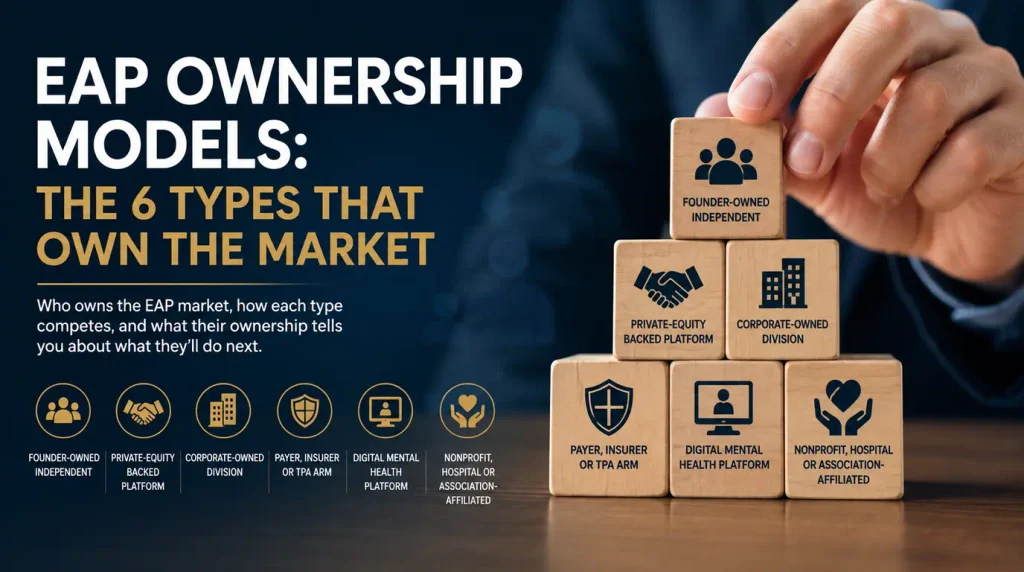
This is who owns the employee assistance program (EAP) market, how each type competes, and what their ownership tells you about what they’ll do next.
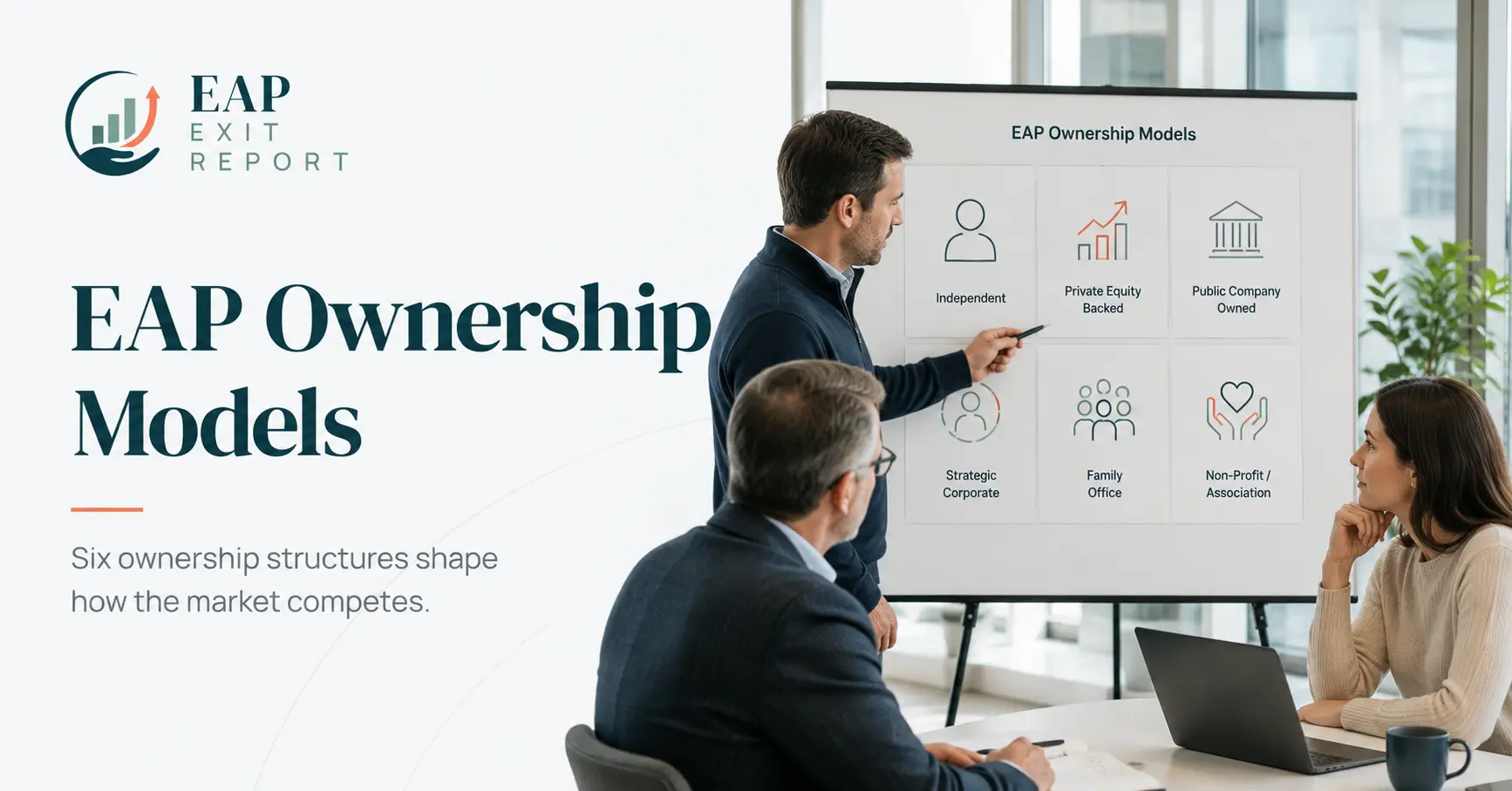
The six EAP ownership models
The taxonomy below is ours. There is no industry-standard classification of EAP ownership models, which is part of why competitor analysis in this sector is usually so thin.
| Model | Typical scale | Primary objective | Time horizon |
|---|---|---|---|
| Founder-owned independent | Regional, sub-scale to mid-market | Sustainable profit, owner income, clinical mission | Indefinite |
| Private-equity-backed platform | Mid-market to large | Value creation for exit | 4–7 years, often longer |
| Corporate-owned division | Large to global | Contribution to a broader group | Indefinite, subject to portfolio review |
| Payer, insurer or TPA arm | Large | Attachment to existing employer relationships | Indefinite |
| Digital mental health platform | Varies widely | Growth, market share, eventual exit or IPO | Investor-driven |
| Nonprofit, hospital or association-affiliated | Regional | Mission delivery, community obligation | Indefinite |
Illustrative framework — not transaction guidance.
Two of these EAP ownership models are documented in public sources. Stone Point Capital lists ComPsych — a global provider of employee assistance and workplace mental health programs under the GuidanceResources brand — as a current portfolio company with an investment year of 2017 recorded at buyout stage (Stone Point Capital, accessed August 2026), which is the sponsor-backed model. TELUS reported that growth in its health services revenues, driven by employee and family assistance program offerings among others, was augmented by targeted acquisitions globally in 2024 and by Workplace Options and other business acquisitions in 2025 (TELUS Corp, Form 6-K, filed 2026), which is the corporate-division model.
The others are present in the market but less consistently disclosed, which is itself worth noting: ownership in this sector is often not public information, and working out who owns a competitor sometimes takes more effort than working out what they charge.
How each one competes against you
Founder-owned independents
Your closest peers, and often your most direct competition for mid-market employer contracts.
They compete on relationship, responsiveness and clinical reputation. They are usually price-disciplined because the owner feels every unprofitable contract personally. They rarely have the reporting infrastructure or multi-country coverage that large employers increasingly ask for.
The thing to watch: this group is shrinking. Every acquisition removes one, and the survivors face the same investment pressures you do.
Private-equity-backed platforms
The most aggressive competitors in most regions, for a structural reason. A sponsor-backed platform is measured on growth toward an exit, which creates appetite for winning contracts that a founder-owner would decline.
They typically have real investment behind systems and reporting, a professionalized sales function, and — this is the part independents underestimate — the ability to absorb a low-margin contract to gain a logo or enter a region.
Among the EAP ownership models, this one is the most predictable if you know where they are in the hold period. Early in a hold, they buy and build. Late in a hold, they focus on margin and clean numbers, and become noticeably less willing to chase marginal business. The private equity thesis piece covers the cycle.
Corporate-owned divisions
An EAP business sitting inside a larger telecom, insurance, benefits or professional services group.
They compete on integration and enterprise credibility — the ability to sell EAP alongside pension administration, benefits, or absence management to a procurement function that prefers fewer vendors. Their pricing is sometimes shaped by group objectives rather than standalone unit economics, which can be difficult to compete against on price alone.
Their vulnerability is that they are subject to group portfolio decisions they don’t control.
Payer, insurer and TPA arms
Similar dynamic, sharper attachment. If an employer already contracts with the payer for health benefits, an EAP is an adjacent product sold into an existing relationship, often at a price that reflects its role as an attachment rather than a standalone service.
Competing against this on a like-for-like basis is difficult. Competing on clinical depth, network density and responsiveness is more viable, and independents frequently do win against payer-owned offerings on exactly those grounds.
Digital mental health platforms
Well-funded, product-led, and selling a different story — engagement data, digital access, measurement-based care, integration with the employer’s benefits stack.
They generally have less clinical network depth in specific geographies and less experience with the operational realities of critical incident response, complex cases and public sector procurement. That gap is real and it is defensible, though it narrows each year.
Nonprofit, hospital and association-affiliated providers
Often strong regionally, frequently anchored to a particular sector or community, and competing partly on mission rather than on commercial terms.
Their constraints are usually capital and governance. They rarely acquire, and they are sometimes acquisition targets themselves when a parent institution reviews non-core activities.
How each one behaves as an acquirer
The reason EAP ownership models matter to a seller as well as a competitor.
| Model | Acquires? | What they buy | What that means for a seller |
|---|---|---|---|
| Founder-owned independent | Rarely | Occasional small tuck-ins | Not usually a realistic buyer |
| PE-backed platform | Frequently | Platforms and add-ons | Rollover often requested; continuing role likely |
| Corporate division | Selectively | Coverage, capability, scale | Cash-weighted, integration-focused |
| Payer / TPA | Selectively | Employer relationships, behavioral capability | Brand usually absorbed |
| Digital platform | Opportunistically | Employer distribution, clinical network | Service may be repositioned around their product |
| Nonprofit / hospital | Very rarely | — | Occasionally a seller, not a buyer |
Illustrative framework — not transaction guidance.
The practical use of this table is buyer-universe construction, and it is where EAP ownership models stop being background reading and start being planning. If you are thinking about who might eventually acquire your business, four of the six models are realistic and two effectively are not. That narrows the list considerably, and it changes who you would want in a process. Who buys EAP companies covers each acquirer type in depth.
What ownership tells you about a competitor’s next move
Three inferences worth drawing from EAP ownership models, because they are actionable.
A sponsor-backed platform that has gone quiet on acquisitions is probably approaching an exit. Late in a hold period, attention shifts from buying to margin and clean reporting. If a regional competitor stops acquiring and starts repricing, that’s a signal — and it may mean their business changes hands within eighteen months, along with their appetite for your accounts.
A newly acquired competitor is temporarily distracted. Post-acquisition integration absorbs enormous management attention: systems migration, contract migration, reporting changes. The twelve months after a competitor is acquired are frequently the best twelve months to compete against them, particularly on service responsiveness, which is exactly what suffers during integration.
A corporate division under group review is unpredictable. If a parent group signals a strategic review or portfolio rationalization, the EAP arm may be sold, wound into another unit, or starved of investment. Any of the three creates opportunity for an independent with stable ownership and a clear story.
How ownership changes hands, and what that means for you
The six EAP ownership models are not fixed positions. Businesses move between them, and the movement is almost entirely in one direction.
Founder-owned independents become sponsor-backed platforms or add-ons. This is the dominant transition and the reason the independent tier keeps shrinking.
Sponsor-backed platforms become corporate divisions, or pass to another sponsor. At the end of a hold period the platform is sold — often to a strategic acquirer, sometimes to a larger financial sponsor in a secondary buyout. Either way the EAP ownership models around you shift again.
Corporate divisions occasionally become independent. Rarer, but real. A group rationalizing its portfolio may divest an EAP arm to management or to a sponsor, and the resulting business re-enters the market with new ownership and new urgency.
Nonprofit and hospital-affiliated providers occasionally sell. Usually when a parent institution reviews non-core activities, and usually to a strategic or sponsor-backed buyer.
Two practical consequences for an independent owner.
The buyer universe for your business narrows over time, not widens. Consolidators fill geographic and sector gaps. Once a platform has adequate coverage in your region or specialty, you become a nice-to-have rather than a strategic priority, and the price reflects it. That is not an argument to sell now; it is an argument to know where you sit in the sequence.
Your competitive set changes without warning. A regional competitor acquired by a well-capitalized platform is a different opponent within eighteen months — same name, different pricing discipline, different investment capacity, different appetite for your accounts.
How to read your own position
Three questions that place you accurately among the EAP ownership models around you.
Who are my three closest competitors, and which of the EAP ownership models do they belong to? If the honest answer is that you do not know, that is worth an afternoon. Sponsor portfolio pages, corporate annual reports and trade press will usually answer it. Ownership predicts behavior more reliably than anything else you could research about them.
Which of the six EAP ownership models is gaining ground in my specific market? Not the sector globally — your region, your employer size band, your sector specialties. If payer-owned offerings are winning mid-market contracts in your area, that is a different competitive problem from digital platforms winning them, and the responses differ.
What would make me acquirable to each of the four models that actually buy? A sponsor wants management depth and clean numbers. A strategic wants transferable contracts and coverage. A payer wants employer relationships. A digital platform wants clinical network and licensure breadth. You are unlikely to be equally attractive to all four, and knowing which one you fit best tells you where to concentrate preparation.
Where independents still win
Worth stating plainly, because a page listing five better-capitalized EAP ownership models could read as an argument that independence is doomed. It isn’t.
Against the other five EAP ownership models, independents consistently win on four grounds:
Responsiveness. A benefits director who can call the owner and get a decision the same day values that more than most platform sales teams believe, and says so at renewal even when the price is not the lowest on the table.
Clinical depth in a defined geography or sector. Network density that took fifteen years to build cannot be assembled quickly by a platform entering a region, and employers with dispersed or specialized workforces notice the difference.
Continuity. Platform-owned providers change account teams, systems and sometimes brand, often more than once in a five-year employer relationship. Employers who have been through two of those transitions become receptive to a provider who won’t put them through a third.
Pricing discipline at scale. Large providers carry central overhead. A well-run independent can serve a mid-market employer profitably at a price a platform struggles to match once allocation is applied.
None of those four advantages requires capital. All four require attention, and attention is the one resource an owner-operated business has more of than a platform does — a regional director reporting into a group structure cannot make the decisions you can make in an afternoon.
Those advantages are real and they are also finite. They erode when employers start requiring capabilities you can’t fund, or when broker channels consolidate around shorter approved-vendor lists. The consolidation pillar works through when independence continues to make sense and when it stops. And the sizing question behind all of this — how much money actually moves through the sector — is in EAP market size, where published estimates for 2025 range from roughly USD 5.3 billion to USD 9.29 billion depending on scope.
Owners weighing their competitive position against the ownership structure of the market around them will find that specialist sell-side firms including Olympic M&A have that conversation years before any process begins.
Frequently asked questions
Who owns EAP companies?
Six ownership models operate in the sector: founder-owned independents, private-equity-backed platforms, divisions of larger corporate groups, payer and third-party administrator arms, digital mental health platforms, and nonprofit or hospital-affiliated providers. Ownership is often not publicly disclosed.
What are the main EAP ownership models?
Founder-owned independents pursue sustainable profit indefinitely. Sponsor-backed platforms pursue value creation toward an exit over four to seven years. Corporate divisions and payer arms serve broader group objectives. Digital platforms pursue growth on investor timelines. Nonprofit and hospital-affiliated providers pursue mission delivery.
How does ownership affect how an EAP competes?
Ownership determines pricing discipline, appetite for low-margin contracts, investment capacity and acquisition intent. Sponsor-backed platforms are typically most aggressive on growth. Payer arms compete through attachment to existing employer relationships. Independents compete on responsiveness, clinical depth and continuity.
Which EAP owners are realistic buyers for my business?
Four of the six models acquire with any regularity: private-equity-backed platforms, corporate divisions, payer and TPA arms, and digital mental health platforms. Founder-owned independents rarely acquire beyond small tuck-ins, and nonprofit or hospital-affiliated providers very rarely acquire at all.
How can I find out who owns a competitor?
Ownership in this sector is frequently undisclosed. Sponsor portfolio pages, corporate group annual reports and regulatory filings are the most reliable public sources. Trade press and broker conversations often identify ownership changes before they are formally announced, though they should be treated as unconfirmed.
Are independent EAP companies still competitive?
Yes, on four specific grounds: responsiveness that platform sales structures struggle to match, clinical network depth in defined geographies or sectors, continuity for employers tired of provider transitions, and pricing discipline unencumbered by central overhead. These advantages erode as capability requirements rise.