
The first time most employee assistance program (EAP) owners encounter private equity is a phone call from someone whose title includes the word “associate,” asking questions that are noticeably better informed than the last three cold calls.
That’s usually the start of a private equity EAP conversation, and it tends to arrive without warning because sponsors do their sector work quietly and approach owners long before those owners are thinking about selling. Understanding why they’re interested — what they’re actually underwriting, and what happens to a business after they buy it — is the difference between having that conversation from a position of knowledge and having it from a position of flattery.
This is the investment thesis, explained from the other side of the table.
How sponsors find EAP companies in the first place
Worth understanding, because it explains why the call felt so well-informed.
Most private equity EAP interest is sourced proprietarily rather than through auctions. A sponsor with a thesis in a sector builds a map of it: every operator of relevant scale, their approximate revenue, their geography, their sector specialties, their ownership, and — the part owners find unsettling — some estimate of the founder’s age and likely retirement horizon.
That map gets maintained for years. Associates work through it methodically, making contact long before anyone is selling, because the goal is to be the relationship that already exists when an owner finally starts thinking about it.
None of this is sinister. It is simply what a well-run origination function does, and every serious private equity EAP buyer has one. But it has two implications for you.
You are probably already on a list. If your business is of any scale in a defined geography, several sponsors know it exists. The call was not a coincidence, and it was not a compliment about something they just noticed.
Being contacted early is an advantage if you use it. A conversation with a sponsor three years before you would sell costs nothing, teaches you a great deal about how the market reads your business, and creates no obligation. The mistake is not taking the call. It is taking the call and then negotiating on it.
Is private equity actually buying EAP companies?
Yes, and it isn’t new.
Stone Point Capital lists ComPsych — a global provider of employee assistance and workplace mental health programs delivered under the GuidanceResources brand — as a current portfolio company, with an investment year of 2017 recorded at buyout stage (Stone Point Capital, company page, accessed August 2026). That is a sponsor holding a major sector asset for the better part of a decade, which tells you the thesis is a considered one rather than a passing enthusiasm.
Strategic consolidation is running alongside it. TELUS has reported that growth in its health services revenues, driven by employee and family assistance program offerings among others, was augmented by targeted acquisitions globally in 2024 and by Workplace Options and other business acquisitions in 2025 (TELUS Corp, Form 6-K, filed 2026).
What we cannot tell you, with a source, is what share of the sector is now sponsor-owned. Nobody has assembled that figure rigorously from disclosed transaction data, and we would rather say so than repeat an estimate we can’t stand behind. The broader market picture is in the consolidation pillar.
Five reasons the private equity EAP thesis works
1. The revenue behaves like a subscription
This is the whole thesis in one line, and everything else is detail.
Per-employee-per-month pricing converts counseling into contracted, employer-paid, recurring income that arrives whether or not anyone calls. Reported PEPM pricing commonly falls somewhere around USD 1–5 per employee per month depending on scope (GlobalGrowthInsights, February 2026). A sponsor looking at that sees annual contracts, high renewal characteristics, and revenue they can model forward with confidence.
Contracted recurring revenue is also what supports leverage, which is the mechanical reason a private equity EAP deal is financeable at all. Lenders will advance against predictable contracted income in a way they will not against project-based service revenue.
2. The payer is an employer, not an insurer
This one is underrated by owners and central for investors.
Most behavioral health investment theses have to price reimbursement risk: payer mix, claims denial, rate compression, credentialing cycles, policy change. An employer-paid EAP removes that entire category. Your counterparty is a corporate budget holder with an annual contract, not a claims department.
For a sponsor comparing behavioral health opportunities, that is a meaningfully cleaner risk profile, and it is a large part of why EAP screens well against clinic-based alternatives.
3. The provider base is fragmented
No private equity EAP roll-up is possible without this, so it sits underneath everything else.
A long tail of regional and founder-owned operators sitting beneath a handful of global providers is the precondition for any buy-and-build. The sector has exactly that shape.
Fragmentation means a sponsor can acquire a platform and then add several smaller books to it over a hold period, growing revenue through acquisition rather than relying entirely on organic growth in a market where organic growth is slow.
4. Multiple arbitrage makes the math work
Here is the part nobody explains to sellers, and it’s worth understanding rather than resenting.
Small independent EAP businesses trade at lower multiples than consolidated platforms do. A sponsor who acquires several sub-scale books at the lower multiple and exits the assembled group at the higher one captures the spread. That spread is not a trick; it reflects genuine differences in scale, systems, management depth and diversification.
Two implications for you. First, this is why a private equity EAP platform may pay you more than a same-sized peer would — they’re buying into an arbitrage you’re not. Second, it explains why they’d like you to roll equity forward: if the spread is real, they want your incentives pointed at it.
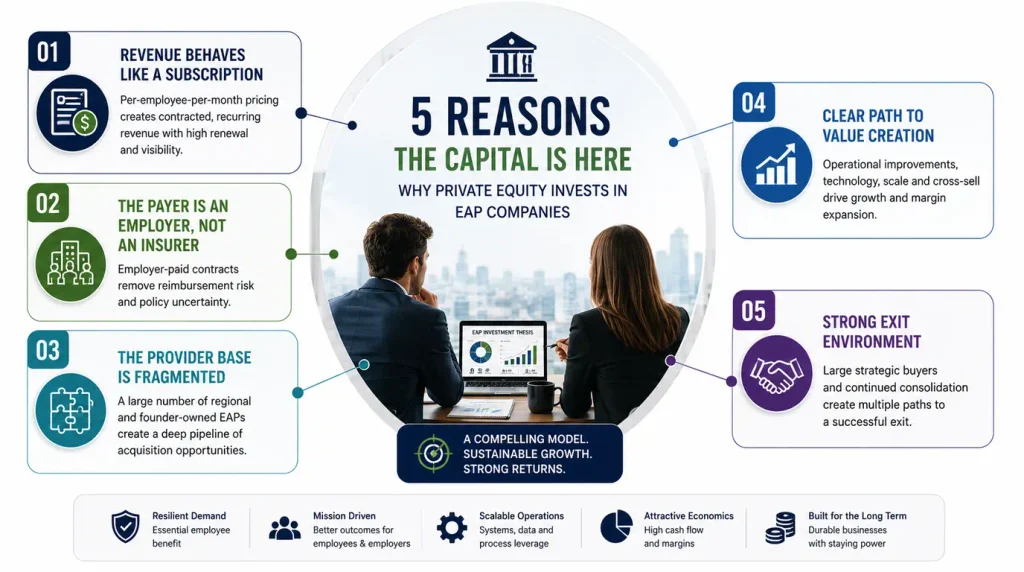
5. Technology is a fixed cost waiting to be spread
Case management platforms, employer reporting, digital front doors, integrations with benefits administration systems. All of it costs roughly the same to build whether you serve 200 employer contracts or 2,000.
Sponsors read that as operating leverage. Build the platform once, spread it across an acquired book, and margin expands without proportional headcount. For an independent owner, the same fact reads as a problem: technology investment that’s affordable at scale is punishing at yours.
Platform or add-on — and why it changes your deal
Every private equity EAP acquisition is one of two things, and which one you are changes almost everything about the transaction.
| Platform | Add-on | |
|---|---|---|
| What they’re buying | A base to consolidate from | Incremental contracted revenue |
| What matters most | Management depth, systems, scale, sector position | Contract quality, geography, network density |
| Your role after | Usually a continuing operating role | Shorter transition, integration into existing operations |
| Rollover equity | Commonly requested, often substantial | Less common, usually smaller |
| Brand | Often retained, at least initially | Usually absorbed |
| Influence on strategy | Real, though shared | Limited |
Illustrative framework — not transaction guidance.
The practical tell: if a sponsor is describing your business as their platform in one meeting and their add-on in the next, that’s information. Platform conversations involve your management team and your systems. Add-on conversations involve your contract file and your geography.
Neither is better. But they are different deals with different lives attached, and owners occasionally negotiate hard on price while agreeing without noticing to a three-year operating role they didn’t want.
What a private equity EAP sponsor does after they buy
Roughly in this order, and worth knowing before you decide whether you want to be there for it.
The sequence below is consistent enough across private equity EAP deals to plan around.
Financial reporting first. Monthly management accounts, contract-level P&L, KPI dashboards, board reporting. Most founder-owned EAPs have never produced this, and the first six months can feel like being audited continuously. It is not a judgment on how you ran things. It’s the infrastructure the next acquisition depends on.
Systems and data second. Case management consolidation, employer reporting standardization, integration work. This is where the technology thesis gets tested.
Then commercial. Pricing review against utilization, sales process formalization, broker channel development. Repricing usually comes after the data supports a case rather than before.
Acquisitions throughout. If you’re the platform, you’ll be integrating other people’s businesses. Some founders find this the most interesting work they’ve done. Others discover they wanted to run a clinical services company, not a corporate development function.
Where you sit at the sponsor’s exit
Most private equity EAP investments are made with an exit in mind from day one, typically a sale of the platform to a larger sponsor, a strategic acquirer, or occasionally a recapitalization. Everything the sponsor does during the hold — reporting, systems, add-on acquisitions, margin work — is aimed at making that exit attractive.
If you took cash and left, this is somebody else’s story. If you rolled equity, it is very much yours, and three things determine what you get.
Where your instrument ranks. If the sponsor holds preferred equity with a return hurdle and you hold common, the proceeds waterfall pays them first. In a strong exit that difference is modest. In a mediocre one it can be the whole difference between a meaningful second payment and a nominal one. Ask this before you agree a rollover percentage, not after.
How much leverage sits on the platform. Debt is repaid before equity sees anything. A platform carrying significant leverage amplifies your outcome in both directions.
Whether you are still there. Leaver provisions — the good leaver and bad leaver definitions — govern what happens to your stake if you exit before the platform does. These are negotiated at the outset and are almost never renegotiated later.
None of that argues against rollover. Owners who rolled into well-run consolidations have done extremely well. It argues for diligencing the sponsor with the same seriousness they applied to diligencing you, which almost nobody does.
What founders get wrong about private equity EAP deals
“They’ll fire my counselors.” Generally not. Clinical delivery is what’s being bought — a sponsor who dismantles the network has purchased contracts they can’t service. Back-office consolidation is the more common change, and it’s more pronounced in add-on deals than platform ones.
“Rollover equity is part of the price.” It isn’t. It’s an investment decision made with post-tax proceeds into a private, illiquid, leveraged company you won’t control. The fact that the money never lands in your account doesn’t change what it is. Ask what instrument you’re holding, where it ranks on exit, and what happens to it if you leave. Pillar 4 covers rollover mechanics.
“The sponsor is the decision-maker in the room.” The person you’re meeting usually needs an investment committee to approve anything. That’s why diligence is thorough and why “we love the business” in month two doesn’t guarantee a signed deal in month five.
“Every private equity EAP buyer is the same.” They are not. Sponsors differ enormously in sector experience, hold discipline, how much they intervene operationally, and how they treat management. A sponsor with prior behavioral health investments will run a faster, better-informed process than a generalist entering the sector for the first time, and will usually be a better owner afterward. Ask what else they have held in adjacent healthcare services.
“Private equity means a bad outcome for the business.” Sometimes. Also sometimes the opposite — capital, systems and management depth that an independent operator genuinely could not fund. The honest position is that outcomes vary by sponsor, by structure and by how well the founder understood what they were signing.
Questions to ask a private equity EAP buyer
Ask these early, before exclusivity, and listen for specificity rather than enthusiasm. Any serious private equity EAP buyer will have considered answers to all six.
- Is this a platform investment or an add-on to something you already own? If it’s an add-on, which platform, and what happens to our brand and team?
- What’s your intended hold period and exit route? This directly determines when rollover equity becomes liquid.
- How many acquisitions do you expect to make in this sector during the hold? Tells you whether you’re buying into a build or a hold.
- What’s your integration plan for clinical delivery specifically? Not general reassurance. Specifics.
- What instrument would my rollover be, and where does it rank against your position on exit? The single most important rollover question, and the one least often asked.
- What does the first twelve months look like for me personally?
A sponsor with a considered private equity EAP thesis will answer all six readily, because they’ve thought about all six. Vagueness on any of them is worth noticing.
The full buyer landscape, including strategics, payers and digital platforms, is in who buys EAP companies, and the checklist buyers work from is in EAP acquisition criteria. Owners weighing an approach from a sponsor often find it useful to understand their own position first — specialist sell-side firms including Olympic M&A have those conversations well before any process begins.
Frequently asked questions
Is private equity buying EAP companies?
Yes. Private equity ownership in the employee assistance sector is established rather than speculative. Stone Point Capital lists ComPsych, a global employee assistance and workplace mental health provider, as a current portfolio company with an investment year of 2017 recorded at buyout stage (Stone Point Capital, accessed August 2026).
Why is private equity interested in EAP companies?
Because EAP businesses combine contracted per-employee-per-month recurring revenue, an employer payer rather than insurance reimbursement, a fragmented provider base suited to consolidation, multiple arbitrage between sub-scale independents and platforms, and technology costs that spread favorably across scale.
What is the difference between a platform and an add-on acquisition?
A platform acquisition buys a base to consolidate from, valuing management depth, systems and scale, and usually involves a continuing operating role and rollover equity. An add-on buys incremental contracted revenue for integration into an existing platform, with a shorter transition and less influence.
What happens to an EAP company after private equity buys it?
Typically financial reporting is professionalized first, then systems and data consolidated, then commercial changes such as pricing review and sales formalization. Further acquisitions often run throughout the hold period. Clinical delivery usually continues; back-office functions are more often consolidated.
Should I take rollover equity in a private equity EAP deal?
Rollover is an investment decision made with post-tax proceeds into a private, illiquid, leveraged company you do not control. Assess the instrument, its ranking on exit, leverage on the platform, the sponsor’s hold period, and leaver provisions. Never accept a rollover percentage you could not afford to lose entirely.
What percentage of EAP companies are private equity owned?
No rigorously sourced figure currently exists. Estimates circulate but are not built on disclosed transaction data. EAP Exit Report is assembling this figure from primary sources for its quarterly Market Update rather than repeating unsourced numbers.