
Owners tend to imagine that buyers assess a business through some proprietary lens they’d never share.
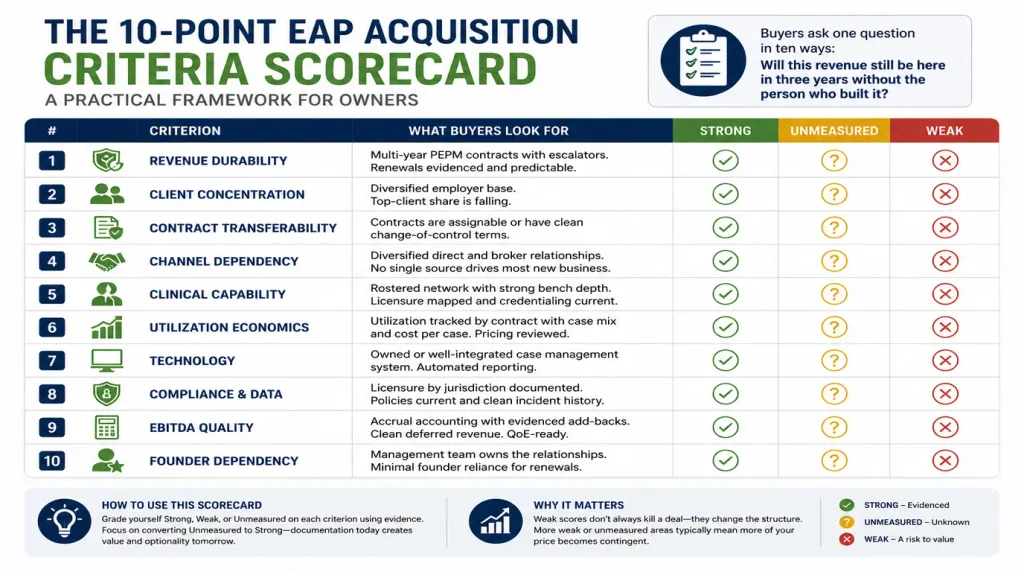
They don’t. EAP acquisition criteria are remarkably consistent across sponsors, strategics and payers, because they all reduce to one question asked ten different ways: will this revenue still be here in three years without the person who built it?
Which means the list is available to you, in advance, and you can score yourself against it before anyone else does. That’s the single most useful hour an employee assistance program (EAP) owner can spend on the subject of selling, and it’s free.
Here’s the scorecard.
One framing note before the list. These EAP acquisition criteria are not a pass-fail test, and no business scores strongly on all ten. Businesses that score strongly on all ten have usually already been bought. What the scorecard tells you is where your specific vulnerabilities are, which is far more actionable than a verdict.
What EAP acquisition criteria actually are
EAP acquisition criteria are the standardized set of factors a buyer scores a target against to decide whether to pursue it, what to pay, and how much of the price to make contingent. They’re applied first as a screen — should we spend time on this — and then again in diligence as a verification exercise.
Two things follow from that structure and both matter to you.
The screen happens before you’re in the room, and it runs on the same EAP acquisition criteria used later in diligence. By the time a buyer calls, they’ve usually formed a preliminary view on half these criteria from public information, broker chatter and sector knowledge. You’re not starting from zero; you’re starting from their assumptions.
Scores against the EAP acquisition criteria don’t just move price, they move structure. A weak score on a criterion rarely kills a deal. It shifts money out of cash-at-closing and into escrow, earnouts or indemnities. That’s why owners sometimes get the number they hoped for and a deal shape they didn’t. Pillar 4 covers how that translation works.
The ten-point scorecard
| # | Criterion | Strong | Weak |
|---|---|---|---|
| 1 | Revenue durability | Multi-year PEPM contracts with escalators, renewals evidenced | Rolling annual, terminable for convenience, renewal unmeasured |
| 2 | Client concentration | Diversified employer base, top-client share falling | One dominant employer, share flat or rising |
| 3 | Contract transferability | Assignable, or clean change-of-control terms | Consent required across the largest contracts |
| 4 | Channel dependency | Diversified direct and broker relationships | One broker or consultant driving most new business |
| 5 | Clinical capability | Rostered network, licensure mapped, credentialing current | Thin bench, key-clinician dependency, coverage gaps |
| 6 | Utilization economics | Tracked by contract with case mix and cost per case | Blended only, or unmeasured |
| 7 | Technology | Owned or well-integrated case management, automated reporting | Manual reporting, integration debt |
| 8 | Compliance and data | Licensure by jurisdiction documented, policies current, clean incident log | Undocumented, cross-border handling unexamined |
| 9 | EBITDA quality | Accrual accounting, evidenced add-backs, QoE-ready | Cash basis, unsupported add-backs |
| 10 | Founder dependency | Management team owns the relationships | Owner personally holds the top renewals |
Illustrative framework — not transaction guidance.
Now the detail on the EAP acquisition criteria owners most often misread.
Criterion 1 — Revenue durability is about the contract, not the rate
Owners hear “durability” and think about how long they’ve served a client. Buyers mean the document.
A twenty-year relationship on a rolling annual agreement terminable on 30 days’ notice scores worse than a five-year relationship on a three-year contract with an escalator. The loyalty is real; it just isn’t transferable, and transferability is what these EAP acquisition criteria are built to measure.
Criterion 3 — Transferability is the one nobody expects
Many employer agreements contain change-of-control or anti-assignment provisions, meaning a sale may require the employer’s consent for the contract to continue.
In a business whose entire value is contracted revenue, a contract that can’t transfer without permission is a contract the buyer can’t fully underwrite. It’s frequently the reason a deal gets structured as an equity sale rather than an asset sale, and it drives holdbacks more often than owners realize.
Build the contract matrix — every agreement, its term, its renewal mechanic, its exact consent language — during exit planning, not during diligence.
Criterion 4 — Channel dependency is the hidden concentration
Everyone measures client concentration. Almost nobody measures broker concentration.
If most of your new business over five years came through one benefits consultant or one brokerage relationship, you have a second concentration problem sitting behind the first. Approved-vendor lists change. Consultants move firms. A buyer will ask where new business originates and will notice if the answer is a single name.
Criterion 6 — Utilization is where specialists separate from generalists
A generalist buyer reads low utilization as healthy margin. A specialist reads it as an employer who may ask hard questions at renewal.
What scores well here isn’t a particular level. It’s evidence that you track utilization, case mix and cost per case by contract, and that pricing has been reviewed against them. That combination says your economics are understood rather than inherited.
Criterion 9 — EBITDA quality is a credibility test, not just an arithmetic one
Buyers are not only checking whether the earnings are accurate. They are checking whether you knew.
An owner who presents accrual accounts, an evidenced add-back schedule and a clean deferred revenue position is demonstrating something beyond good bookkeeping: that they understand their own business at the level a buyer needs. An owner whose numbers are restated downward during diligence has demonstrated the opposite, and it colors how every other one of the EAP acquisition criteria gets read afterward.
This is why financial cleanup ranks so high despite being the least interesting item on the list.
Criterion 10 — Founder dependency is priced directly
The uncomfortable one. If your name is on the top three renewals, buyers respond in one of two ways: keeping you longer than you wanted, or making more of the price contingent on you staying. Both are the same discount in different clothing.
How to grade yourself against the EAP acquisition criteria
Take the ten EAP acquisition criteria and give yourself one of three grades on each. Not two.
Strong — you could evidence this to a stranger tomorrow, from records. Weak — you know it’s a problem and you could describe it accurately. Unmeasured — you don’t actually know.
That third grade is the important innovation, and it’s where most owners land more often than they expect. Renewal rate you’re confident about but have never calculated. Utilization by contract you’ve never built. Broker origination you’ve never tracked.
Be strict. “I’m fairly sure our retention is around 92%” is Unmeasured, not Strong. The test is whether you could hand a stranger a folder tomorrow and have them reach the same conclusion without asking you a single question. If they would need to ask, it is not evidence yet.
Then count. In our transaction experience, a business with seven or more Strong grades runs a straightforward process. A business with four or more Unmeasured grades has a preparation project, not a sale, and is far better off spending twelve months converting Unmeasured into Strong before talking to anyone.
How scores translate into deal structure
This is the part owners miss, and it explains why two businesses can receive the same headline offer and end up with very different outcomes.
A weak score on an EAP acquisition criterion does not usually reduce the price a buyer names. It changes where that price sits.
| Weak criterion | Typical structural response |
|---|---|
| Client concentration | Earnout tied to the specific contract renewing, or a targeted indemnity |
| Contract transferability | Holdback pending consents; deal structured as equity rather than asset sale |
| Founder dependency | Longer required transition, retention consideration, or price contingent on your continued involvement |
| EBITDA quality | Purchase price adjustment after the quality-of-earnings review, plus a larger escrow |
| Utilization economics unmeasured | Conservative forward model, which reduces the earnings figure being multiplied |
| Clinical bench depth | Retention arrangements for key affiliates as a closing condition |
Illustrative framework — not transaction guidance.
Read that table alongside the scorecard and something becomes clear: the criteria you score weakly on determine how much of your money is contingent. An owner scoring poorly on three criteria may still be offered an attractive number, and then discover that half of it depends on events over the following three years.
That is why grading yourself honestly against the EAP acquisition criteria matters more than negotiating hard. Negotiation happens once, under time pressure, against people who do it professionally. Preparation happens over quarters, on your own terms, and it removes the reasons a buyer has to hold money back.
What “unmeasured” costs you
This is the practical heart of the whole exercise, so it’s worth stating plainly.
A buyer assumes the conservative case for anything you cannot evidence. Not the average case. The conservative one, because their investment committee requires defensible assumptions and “the owner said so” is not defensible.
So an unmeasured renewal rate doesn’t get modeled at your actual retention. It gets modeled at a rate the analyst can defend, which is lower. Unmeasured utilization economics get modeled with a cost assumption that protects the buyer. Unmeasured broker dependency gets treated as concentrated until proven otherwise.
Each individual conservatism is small. Stacked across four or five EAP acquisition criteria, they compound into a materially different forecast — and the forecast is what gets multiplied.
The good news, and it is genuinely good news: converting Unmeasured to Strong is usually documentation work rather than business change. Renewal history exists in your contract files. Utilization exists in your case management system. Broker origination exists in whoever’s memory or CRM. It needs assembling, not creating. Most of it is a series of evenings with a spreadsheet, and it is the cheapest value creation available to an EAP owner anywhere.
Which EAP acquisition criteria different buyers weight most
The ten are universal. The weighting is not.
| Buyer type | Weights most heavily | Cares less about |
|---|---|---|
| Private equity platform | EBITDA quality, founder dependency, technology, management depth | Brand, geographic fit |
| Strategic consolidator | Contract transferability, geography, network density, client concentration | Your systems — they have their own |
| Payer or TPA | Employer relationships, compliance and data, scale | Standalone brand |
| Digital mental health platform | Employer relationships, clinical network, licensure coverage | Legacy technology |
Illustrative framework — not transaction guidance.
This is why the same business can be a strategic priority to one buyer and a marginal opportunity to another, and why running a plural process matters more than negotiating hard with a single party. A weakness that reprices you with one buyer type may barely register with another. Who buys EAP companies sets out the four classes in full, and TELUS’s disclosure of Workplace Options among its 2025 acquisitions (TELUS Corp, Form 6-K, filed 2026) is a reminder that strategic and sponsor interest run concurrently in this sector.
When to re-score
Once is useful. Annually is where this earns its keep.
Set a date — the same month each year, after your busiest renewal cycle — and re-grade all ten. It takes an hour once the underlying data exists, and it does three things a one-off assessment cannot.
It shows direction. A criterion moving from Unmeasured to Strong is progress you can see. A criterion sliding from Strong to Weak — concentration creeping up as one client grows, bench depth thinning as affiliates retire — is an early warning you would otherwise notice two years late.
It disciplines the preparation work. Most exit planning stalls because nobody is accountable for it. An annual re-score converts a vague intention into a review with a date on it.
It keeps your timing honest. Owners tend to decide when to sell based on how they feel about the business, which is heavily influenced by whatever happened last quarter. A scorecard trend is a steadier signal. If seven criteria are Strong and improving, you have options. If four are Unmeasured and have been for three years, the decision to sell has been made for you by inaction.
The same ten EAP acquisition criteria work equally well as a management tool. Every one of them describes a business that is easier and more profitable to run, whether or not it is ever sold.
Score yourself first. Then decide who you’d want in the room. Owners who want that assessment tested against how buyers are actually behaving right now will find that specialist sell-side firms including Olympic M&A run through exactly this scorecard with owners years before a process, at no cost.
The verification version of this list — what a buyer asks for to prove each criterion — is in EAP due diligence.
Frequently asked questions
What are EAP acquisition criteria?
EAP acquisition criteria are the standardized factors buyers score a target against to decide whether to pursue it, what to pay and how much of the price to make contingent. They cover revenue durability, concentration, contract transferability, channel dependency, clinical capability, utilization economics, technology, compliance, EBITDA quality and founder dependency.
What do buyers look for in an EAP business?
Buyers look for revenue they can rely on after the founder leaves. That means multi-year contracts with evidenced renewals, diversified employer and broker relationships, transferable contracts, documented clinical network depth, tracked utilization economics, clean accrual accounting and a management team that owns client relationships.
What makes an EAP company attractive to buyers?
Contracted per-employee-per-month revenue on multi-year terms, low client and channel concentration, clean change-of-control provisions, a rostered clinician network with mapped licensure coverage, contract-level utilization and cost-per-case data, accrual accounting with evidenced add-backs, and minimal founder dependency.
Do all buyers use the same acquisition criteria?
The criteria are broadly universal but the weighting varies. Private equity platforms emphasize EBITDA quality, founder dependency and technology. Strategic consolidators emphasize contract transferability, geography and network density. Payers emphasize employer relationships and compliance. Digital platforms emphasize clinical network and licensure coverage.
How do I know if my EAP company is ready to sell?
Grade yourself Strong, Weak or Unmeasured on each of the ten criteria using evidence rather than impression. Businesses scoring Strong on seven or more generally run straightforward processes. Four or more Unmeasured grades indicates a twelve-month preparation project rather than readiness.
Why does unmeasured data reduce my valuation?
Buyers assume the conservative case for anything that cannot be evidenced, because investment committees require defensible assumptions. Unmeasured renewal rates, utilization economics and channel origination each get modeled conservatively, and stacked together they materially reduce the forecast that determines value.