

An offer arrives with a headline figure. Somewhere in the second or third page, a portion of it is described as contingent, and there’s a paragraph explaining that this EAP earnout will be paid on achievement of agreed targets over the following two or three years.
Most employee assistance program (EAP) owners read that paragraph as a formality. An EAP earnout looks, at first reading, like a detail of timing rather than a question of whether. The targets look achievable, the business has grown steadily, and the buyer seems reasonable about it.
Then, two years later, the target is hit on the seller’s numbers and missed on the buyer’s, because nobody defined the metric tightly enough to survive a disagreement. That is how earnout disputes actually happen. Almost never bad faith. Almost always definitions.
This is what to negotiate, and when.
What an EAP earnout actually is
An EAP earnout is a portion of the purchase price paid only if the business meets agreed performance targets after closing, typically measured over one to three years. It is not a bonus and it is not upside. It is part of the price you were quoted, moved into the future and made conditional.
That framing matters because of how offers get presented. A buyer saying “we’re at eight” when three of those eight sit in an EAP earnout has quoted a number you may receive. A buyer saying “five at close, three contingent” has quoted the same deal honestly. Insist on the second version of every offer before you compare anything.
The purpose from the buyer’s side is legitimate. They are underwriting a forecast, and some of that forecast depends on things they cannot verify in diligence — whether a large contract renews, whether revenue holds through a transition, whether the growth you projected materializes. An earnout moves that specific uncertainty back onto the person who created the projection.
Which is fair enough as a principle. The question is always whether the specific mechanics are fair, and mechanics are where the money is.
Why EAP earnouts appear so often in this sector
More often than in many services businesses, for three structural reasons that are worth understanding because they tell you what to fix in advance.
Client concentration. EAP books frequently have one employer carrying a substantial share of revenue. A buyer cannot verify that relationship in diligence — they’ve never met the benefits director, and the contract renews after they own it. So the concentrated portion gets attached to an earnout tied to that specific renewal. This is the single most common EAP earnout trigger in the sector.
Change-of-control provisions. Many employer agreements require consent or carry termination rights on a change of ownership. Where the largest contracts contain them, buyers hold back price against the risk those consents don’t come through. The change-of-control piece covers the mechanics.
Founder-held relationships. If the top renewals travel with you personally, the buyer’s forecast depends on your continued presence. An earnout is how they finance that dependency without paying for it upfront.
Notice that all three are scorecard items. Every one of them is improvable over twelve to twenty-four months, which is the argument for exit planning rather than better negotiation. You cannot negotiate away a risk that genuinely exists. You can eliminate it beforehand.
The five terms that decide everything
1. The metric
Revenue retention, EBITDA, contract renewals, new business won, or some blend. This choice matters more than the target level.
Revenue retention is usually the safest for a seller. It’s objective, it’s measured from contracts that already exist, and it’s harder for the buyer’s own decisions to distort.
EBITDA is the most dangerous. After closing, the buyer controls costs. They may allocate corporate overhead to your business, invest in systems, add compliance headcount, or change the delivery model. Every one of those is a legitimate business decision and every one of them reduces the number your EAP earnout is measured against. If EBITDA is the metric, you need an exhaustive list of excluded costs, written into the agreement.
Contract renewal triggers are clean but binary. “The X contract renews for a term of at least two years by 31 March 2028” is unambiguous. It’s also all-or-nothing, and renewal timing in this sector slips for reasons that have nothing to do with performance.
2. The measurement period
The length of an EAP earnout changes its character, not just its duration.
One year, two, three. Longer periods increase the chance the business you’re measured on no longer resembles the business you ran.
There’s a specific problem with EAP earnout timing worth flagging: renewal cycles don’t align with measurement dates. If your largest employer habitually renews in the second quarter but the earnout measures at calendar year end, a renewal that lands three weeks late costs you the payment entirely. Ask for the measurement date to follow the renewal calendar, or for a defined grace period. This is a drafting detail that costs nothing to fix at LOI stage and is impossible to fix later.
3. Who controls the outcome
Ask yourself plainly: after closing, can I actually influence this number?
If you’re staying on with authority over sales, pricing and account management, an EAP earnout is a bet on yourself and that’s a reasonable bet to take. If you’re exiting in six months while the earnout runs three years, you’re betting on someone else’s execution with your own money. Those two situations deserve completely different discounts.
Where you have no control, the honest position is that the earnout is worth substantially less than face value, and it should be priced that way in your comparison of offers.
4. What happens if the buyer changes the business
Integration into a larger platform, migration of contracts onto the acquirer’s paper, repricing, changing the clinical delivery model, consolidating your account management team into theirs. All normal post-acquisition activity. All capable of moving your earnout metric for reasons unrelated to how the business performs.
This is what protective covenants are for, and they are covered below because they matter more than any other term on this list.
5. What happens if you leave
Voluntarily, involuntarily, or through ill health. If the earnout is tied to your continued employment, the definitions of “good leaver” and “bad leaver” decide whether a change in your circumstances costs you the entire contingent payment.
Owners in their sixties negotiating a three-year earnout should read this clause with particular care, and should ask what happens on death or incapacity. It is an uncomfortable conversation and it is a great deal less uncomfortable now than it would be for a family later.
Cliff versus slope
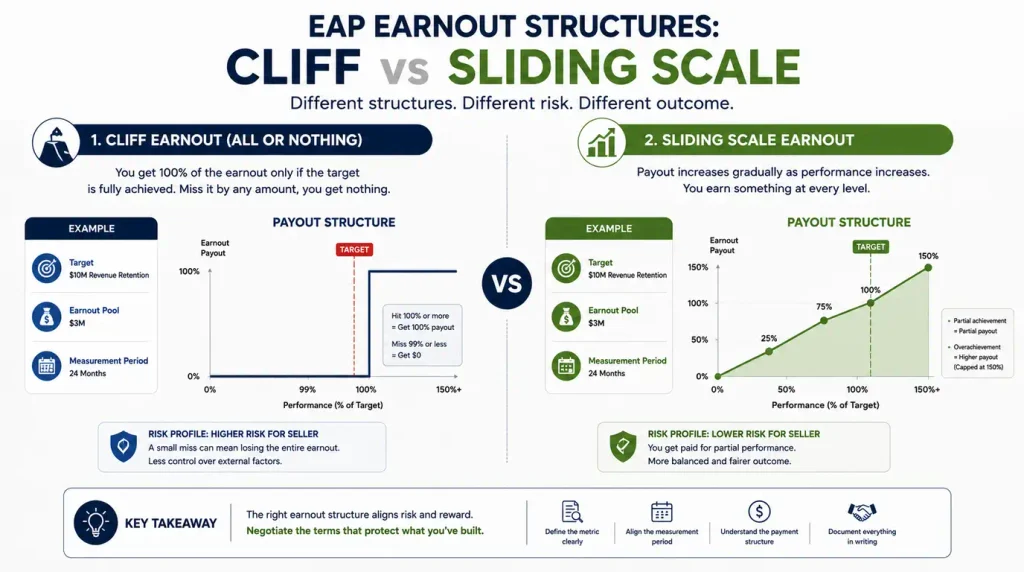
| Cliff | Sliding scale | |
|---|---|---|
| How it pays | Full amount at target, nothing below | Proportional payment from a defined floor |
| At 98% of target | Zero | Roughly 98% of the earnout |
| Risk profile | Binary, all-or-nothing | Graduated |
| Who it favors | The buyer | The seller |
| Typical framing | “Simple and clear” | “Fair to both sides” |
Illustrative framework — not transaction guidance.
Cliffs get proposed because they’re simple. They fail badly, and they fail in the specific circumstance that is most common: narrowly missing.
A business that delivers 96% of an ambitious target has performed well. Under a cliff, it receives nothing, and the seller spends years knowing that a single delayed renewal cost them a seven-figure payment. Under a sliding scale from, say, 85%, the same performance pays most of the earnout.
If you negotiate one thing about your EAP earnout, negotiate the slope. It is usually easier to win than a higher target, because a buyer’s objection to a sliding scale is aesthetic rather than economic — they’re paying for performance either way.
Ask also about a catch-up mechanism across periods. If year one misses and year two substantially over-delivers, a cumulative measurement lets the second make up for the first. Buyers often accept this because it aligns everyone with the multi-year outcome they actually care about.
Protections worth more than the percentage
These are the clauses that determine whether the metric you agreed still means anything in eighteen months. Negotiate them before exclusivity.
Operational covenants. The buyer agrees to run the business in the ordinary course during the earnout period, and not to take specified actions — repricing contracts, changing the delivery model, reassigning account managers, migrating employer agreements — without consent or without adjustment to the metric.
Cost allocation limits. If EBITDA is the metric, define exactly which costs can be charged to the business. Corporate management fees, shared services allocations, acquisition costs, and integration expenses should all be explicitly excluded.
Acceleration on sale. If the buyer sells the platform during your earnout period, the earnout should accelerate and pay out. Otherwise your metric is now being measured inside a business owned by someone who never agreed to it.
Information rights. You should receive the underlying calculation, with supporting detail, on a defined schedule — not a one-line statement at the end. Without this you cannot dispute anything, because you cannot see anything.
A dispute mechanism. An independent expert, appointed within a defined period, with cost allocation specified. This clause costs nothing when relations are good and is worth a great deal when they are not.
Set-off restrictions. Buyers sometimes reserve the right to offset warranty claims against earnout payments. Resist it, or at minimum require the claim to be agreed or determined before any offset applies.
How to compare an offer with an earnout against one without
Two offers arrive. One is eight, with three of it in an EAP earnout over three years. One is six and a half, all cash at closing.
Owners compare eight against six and a half. That comparison is meaningless, and it is how people talk themselves into structures they later regret.
The comparison that works has three steps.
Step one: discount the contingent portion by your honest probability of collecting it. Not the buyer’s projection. Yours, informed by whether you control the metric, how long the period runs, and how tightly the terms are defined. An EAP earnout you can influence directly, measured on revenue retention over eighteen months, might reasonably be discounted lightly. One measured on EBITDA over three years in a business you exit in six months should be discounted heavily.
Step two: apply a time discount. Money in three years is worth less than money now, and the gap is larger than most people intuitively price. Whatever return you would expect on the cash if you received it at closing, apply it.
Step three: add the cost of your own time. If the earnout requires you to stay, and the role is compensated below market, the shortfall is a real cost of that structure and belongs in the arithmetic.
Run those three steps and the eight-with-an-earnout frequently lands below the six-and-a-half all cash. Sometimes it doesn’t, and then you’ve confirmed the higher offer is genuinely higher rather than merely larger.
Do this on paper before you have a preference. The order matters — once you’ve decided which buyer you like, the arithmetic tends to arrive at whatever conclusion you were already heading toward.
When to refuse an EAP earnout
Rarely outright — refusing all contingent consideration in a market where it’s normal will narrow your buyer universe. But there are three situations where declining is the right call.
When you’re exiting immediately and the period is long. A three-year earnout on a business you leave in six months is not consideration. It’s a lottery ticket priced as cash, and you should either negotiate a shorter period, take a lower all-cash number, or find a different buyer.
When the metric is EBITDA and the buyer won’t define exclusions. Reluctance to specify cost allocation is the clearest warning sign in this whole area. A buyer who intends to measure fairly has no reason to resist writing down how.
When the earnout is doing the work of a valuation disagreement. Sometimes contingent consideration is a genuine risk-sharing mechanism. Sometimes it’s a way of bridging a gap between what you want and what the buyer will pay, with the bridge built entirely from your money. If the earnout portion is very large relative to cash at closing, ask yourself which of the two is happening.
Consolidation in this sector is active and well capitalized — TELUS reported Workplace Options among its 2025 business acquisitions (TELUS Corp, Form 6-K, filed 2026) — which means most owners running a proper process have alternatives. Alternatives are what make it possible to decline a structure rather than accept one.
The wider mechanics of how a price gets split across cash, escrow, earnout and rollover are in the deal structures pillar, and the rollover question specifically is in rollover equity in an EAP sale. Owners looking at contingent consideration for the first time will find that specialist sell-side firms including Olympic M&A work through these mechanics with owners before an offer is on the table, which is the only time the terms are genuinely negotiable.
Frequently asked questions
What is an earnout in an EAP deal?
An EAP earnout is a portion of the purchase price paid only if the business achieves agreed performance targets after closing, usually measured over one to three years. In employee assistance program transactions it is commonly tied to contract renewals, revenue retention or EBITDA.
Why do EAP deals so often include earnouts?
Three structural features drive it: client concentration that buyers cannot verify in diligence, change-of-control provisions in employer contracts that create consent risk, and founder-held relationships that make the forecast dependent on the seller. All three are improvable over twelve to twenty-four months of preparation.
What is the safest earnout metric for a seller?
Revenue retention is generally safest because it is objective, measured from existing contracts, and less distorted by the buyer’s post-closing decisions. EBITDA is the riskiest, because the buyer controls costs after closing and can reduce the measured figure through legitimate business decisions.
What is the difference between a cliff and a sliding scale earnout?
A cliff pays the full earnout at target and nothing below it, so narrowly missing pays zero. A sliding scale pays proportionally from a defined floor, so performance at 96% of target pays most of the earnout. Sliding scales substantially favor the seller.
What protections should an EAP earnout include?
Operational covenants requiring ordinary-course management, explicit cost allocation exclusions if EBITDA is the metric, acceleration if the buyer sells the platform, information rights over the calculation, an independent dispute mechanism, and restrictions on offsetting warranty claims against earnout payments.
Should I accept an earnout if I am leaving the business?
Treat it with caution. An earnout measured over three years on a business you exit in six months depends entirely on someone else’s execution. Either negotiate a shorter measurement period, accept a lower all-cash figure, or discount the contingent amount heavily when comparing offers.