

Somewhere in your largest employer agreement, probably under a heading like “Assignment” or “Miscellaneous,” there is a paragraph about what happens if your company is sold.
Most employee assistance program (EAP) owners have never read it. It was drafted by the client’s procurement lawyer, it appeared in the template, and there was no reason at the time to look. That change of control language is now one of the most consequential facts about your business, and there is a reasonable chance you cannot say what it says.
Generalist M&A content treats change of control language as boilerplate. In this sector they are not boilerplate. They routinely determine how a deal is structured, how much of the price you receive at closing, and whether you end up telling your clients about a sale months before you wanted to.
What a change of control clause does
A change of control clause gives a contracting party specific rights if ownership of the other party changes. Depending on the drafting, those rights can range from a requirement to be notified, through a requirement to give consent, up to a right to terminate the agreement outright.
A closely related provision, often in the same paragraph, is the anti-assignment clause, which restricts transferring the contract to another entity without permission.
The two interact, and the distinction matters enormously in practice:
- Assignment provisions are typically triggered when the contract itself moves to a different legal entity.
- Change of control provisions are typically triggered when the ownership of the contracting entity changes, even if the contract stays exactly where it is.
A buyer’s counsel will read both, in every contract, and build a matrix. The question they’re answering is simple: after we buy this business, do we still have these contracts, and what do we have to do to keep them?
Why this matters more in EAP than almost anywhere
Because in this sector, the contracts are the business.
An EAP company’s value sits almost entirely in contracted, recurring, employer-paid revenue. Strip out the employer agreements and what remains is a clinician network and a case management system — useful, but not what anyone is paying a multiple for. So a change of control provision that puts contracted revenue at the discretion of a third party goes directly to the thing being purchased.
Three sector-specific factors sharpen it further.
Procurement-drafted contracts. EAP agreements are usually written on the employer’s paper, often by a corporate procurement or legal function protecting the employer’s interests. Vendor-favorable assignment language is rare.
Public sector and institutional clients. Hospital systems, municipalities, school districts and government bodies frequently have the strictest provisions, sometimes requiring formal re-procurement on a change of ownership. These are also, very often, exactly the long-standing anchor clients that make up a concentrated revenue position.
Confidentiality collides with consent. Obtaining consent means telling the client the business is being sold. That collides directly with wanting to keep a transaction confidential until it’s certain, and it means a large employer learns about the sale at precisely the moment they’re deciding whether to renew.
The four flavors of clause
Not all change of control language does the same thing. In rough order of how much trouble it causes a seller:
| Flavor | What it says | Impact on a deal |
|---|---|---|
| Silent | The contract says nothing about ownership change | Best case. Generally transfers with the entity in an equity sale. |
| Notification | You must inform the client within a defined period | Manageable. Sequencing question, not a consent risk. |
| Consent required | Assignment or change of control requires the client’s written consent, often “not to be unreasonably withheld” | The common case. Creates real risk, and the “not unreasonably withheld” qualifier is worth much less in practice than it reads. |
| Termination right | The client may terminate on a change of control, sometimes without cause or notice | Worst case. Puts that revenue entirely at the client’s discretion. |
Illustrative framework — actual contract language varies and should be reviewed by counsel.
The distribution across a typical book is uneven, and it correlates badly for sellers: the largest and longest-standing contracts tend to carry the strictest provisions, because they were won through formal procurement processes with sophisticated legal review.
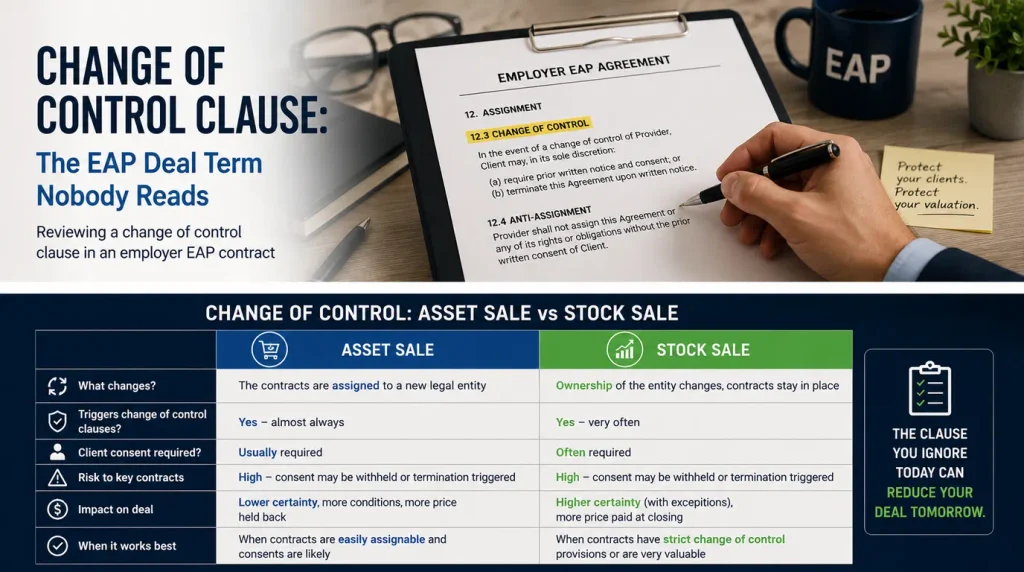
Why it decides asset sale versus stock sale
Here is the part that generalist explainers get backward.
Everyone knows buyers prefer asset sales and sellers prefer equity sales, and everyone attributes this to tax and liability. Both are real. In EAP transactions, there is often a third factor that overrides both.
| Asset sale | Equity / stock sale | |
|---|---|---|
| What transfers | Named assets and assumed liabilities | The entity itself, with everything in it |
| Contract treatment | Contracts are assigned to a new entity | Contracts stay with the same entity |
| Assignment clauses | Generally triggered | Generally not triggered |
| Change of control clauses | Generally triggered | Often also triggered — depends on drafting |
| Buyer preference | Usually preferred | Less preferred |
| Seller preference | Less preferred | Usually preferred |
Illustrative framework — not transaction guidance. Tax and liability treatment differ by structure, entity type and jurisdiction; consult your own advisors.
The practical consequence: if your major employer contracts contain assignment restrictions but are silent on change of control, an equity sale may avoid consent requirements that an asset sale would trigger. That single fact has determined the structure of a great many services-business transactions.
But note the row that matters most. A clause drafted to capture change of control — not merely assignment — will typically catch an equity sale too, because the trigger is the ownership change rather than the transfer of the paper. Owners who have heard “just do a stock sale and it’s fine” are relying on a generalization that depends entirely on the specific wording in each contract.
There is no substitute for reading them.
There is a second-order point here that owners find genuinely useful once they see it. Because the structure decision often turns on contract language rather than tax, the buyer’s preferred structure tells you something about what they found in your contract file. A buyer who opens by proposing an equity purchase, in a market where buyers usually prefer asset deals, has probably concluded that your assignment provisions make an asset sale expensive. That is a signal worth noticing, and it is available to you weeks before anyone explains it.
How the risk gets priced
Buyers do not usually walk away from change of control exposure. They price it, and they do so in one of four ways.
Consents as a closing condition. The deal doesn’t complete until specified consents are obtained. Cleanest for the buyer, most exposed for the seller — you may be some way into the process before discovering a client is slow, indifferent, or using the moment to renegotiate.
Price holdback. A portion of consideration is withheld until consents come through, released as they do.
Earnout tied to contract survival. The concentrated or consent-dependent revenue is moved into contingent consideration measured on whether those contracts renew post-closing. This is one of the most common EAP earnout triggers in the sector.
Specific indemnity. You remain liable for a defined period if the identified contracts terminate as a result of the transaction.
All four move risk to you. Which is why the fix is not negotiation but preparation: the time to soften a change of control provision is at an ordinary renewal, months or years before any transaction exists, when you are simply a vendor updating contract terms rather than a seller with an obvious motive.
Some clients will decline. Many will accept a notification requirement in place of a consent requirement, or a “consent not to be unreasonably withheld, with deemed consent after thirty days” formulation, because from their perspective it is a minor administrative point. It is only a major point when they know you need it.
What to do when the clause is already bad
Suppose you build the matrix and your three largest contracts all carry consent requirements, one with an outright termination right. That is a common finding, and it is not a disaster. It is a project with a sequence.
First, do nothing sudden. Approaching a major client to renegotiate a change of control provision immediately after deciding to sell is exactly the pattern that makes a client curious. The renegotiation has to look like ordinary contract housekeeping, which means it has to happen at a normal renewal, ideally alongside other routine updates.
Second, work out what the client actually cares about. Most procurement functions insert consent language to protect service continuity, not to control your ownership. That means the objection is often satisfiable without removing the clause. A commitment to service-level continuity, named account team continuity, or a defined transition protocol can sometimes be traded for softening a consent requirement into a notification requirement.
Third, aim for the achievable version. Full removal of a change of control clause is unlikely. “Consent not to be unreasonably withheld, with deemed consent after thirty days” is a realistic target and does most of the practical work, because it converts an open-ended risk into a bounded one that a buyer can price cheaply.
Fourth, if the clause cannot be moved, say so early. A seller who discloses a difficult provision at the outset, with the revenue at stake quantified and a view on how the client is likely to respond, is in a far stronger position than one whose buyer’s counsel finds it in week three. The first is a known risk being managed. The second is a surprise, and surprises during exclusivity get priced.
Who reviews this, and when
Not your general commercial lawyer, and not at the point a buyer appears.
The review you need is a healthcare or services M&A counsel reading the whole contract file for transferability, ideally twelve to twenty-four months before any process. That is a defined, bounded piece of work — it is not a retainer, and it does not commit you to anything. What it produces is a marked-up matrix telling you which contracts transfer cleanly, which need consent, which carry termination rights, and which of those are worth trying to renegotiate at the next renewal.
Ask any lawyer you’re considering how many contracted-services or behavioral health transactions they have closed. A change of control clause reads as boilerplate to someone who has not watched one reshape a deal.
Building your contract matrix
This is the deliverable, and it’s an afternoon’s work per twenty contracts.
For every employer agreement, record:
- Client name and revenue — current year and prior two
- Contract start date and remaining term
- Renewal mechanic — auto-renewal, formal re-procurement, rolling
- Notice period for non-renewal or termination
- Termination for convenience — present or absent, and on what notice
- Assignment clause — exact wording, quoted
- Change of control clause — exact wording, quoted, and which of the four flavors it is
- Price escalator — present or absent
- Governing law
Quote the language rather than summarizing it. Summaries lose the qualifier that turns out to matter — “not to be unreasonably withheld” versus silence on the point is the difference between a manageable risk and an open-ended one — and you will want the exact words in front of you when counsel reviews the file.
Keep it as a living document. Update it at every renewal, and note when a change of control provision improves or worsens, because the direction of travel across your top five contracts is itself a useful signal about how transferable the business is becoming.
Then sort by revenue and look at the top five. If your largest contracts carry consent or termination provisions, you have a two-year project rather than a deal problem — and knowing that now is worth considerably more than discovering it in due diligence.
Consolidation in this sector is active, and buyers are experienced at reading these files — TELUS reported Workplace Options among its 2025 business acquisitions (TELUS Corp, Form 6-K, filed 2026). Assume the buyer’s counsel will understand your contracts better than you do within about three weeks of gaining access to the file. The only real defense is to have understood them first, on your own timetable, while there is still time to do something about what you find.
The full sequence this fits into is in the guide to selling an EAP business, and how the resulting risk translates into price components is in the deal structures pillar. Owners who want their contract file reviewed for transferability before deciding anything will find that specialist sell-side firms including Olympic M&A do exactly that work years ahead of a process.
Frequently asked questions
What is a change of control clause?
A change of control clause gives a contracting party specific rights if ownership of the other party changes. Depending on drafting, those rights range from notification, through a requirement for written consent, up to a right to terminate the agreement following a sale of the business.
Why do change of control clauses matter in an EAP sale?
Because an EAP company’s value sits almost entirely in contracted employer revenue. A provision that lets a client withhold consent or terminate after a sale puts the acquired revenue at a third party’s discretion, which buyers respond to through holdbacks, earnouts, closing conditions or indemnities.
Does a stock sale avoid change of control clauses?
Not necessarily. An equity sale often avoids assignment restrictions because the contract stays with the same entity. However, clauses drafted specifically to capture a change of control are usually triggered by the ownership change itself, regardless of structure. Only the exact contract wording determines this.
What is the difference between an asset sale and a stock sale for an EAP company?
In an asset sale the buyer acquires specified assets and assumes specified liabilities, and contracts are assigned to a new entity. In a stock or equity sale the buyer acquires the entity itself, so contracts remain in place. Assignment restrictions are generally triggered by the first and not the second.
Can I change a change of control clause before selling?
Often, at an ordinary renewal well before any transaction exists. Many clients will accept a notification requirement in place of a consent requirement, or deemed consent after a defined period, because it is administratively minor to them. It becomes far harder to negotiate once a buyer is involved.
How do buyers price change of control risk?
Through four mechanisms: making specified consents a condition of closing, holding back part of the purchase price until consents are received, tying an earnout to the affected contracts surviving after closing, or requiring a specific indemnity from the seller for a defined period.