

Suppose two offers land in the same week at the same headline number. One is from a strategic buyer — an established employee assistance program (EAP) or behavioral benefits group looking to add your book. The other is from a private equity platform.
Same money. Two completely different next five years.
Owners tend to treat this as a price comparison, discover late that it never was, and end up in a structure that suits someone else’s plan rather than their own. This is what actually separates the two, and the six questions that will tell you which one you want.
What each buyer is actually buying
Start here, because everything downstream follows from it.
A strategic buyer is buying your revenue and your coverage. They already operate an EAP business. They have a clinical model, a case management system, a finance function and a sales team. What they lack is your employer contracts, your geography, your sector specialty, or your network density in a region they can’t easily enter. Consolidation of this kind is active and cross-border — TELUS reported Workplace Options among its 2025 business acquisitions (TELUS Corp, Form 6-K, filed 2026).
Because they have the infrastructure, they don’t need yours. That’s the source of both the good news and the bad news in a strategic deal.
A private equity platform is buying a business. They don’t operate an EAP. They’re acquiring the whole apparatus — your team, your systems, your management, your market position — either as a base to consolidate from or as an add-on to a platform they already own. The private equity thesis piece covers why they’re in the sector at all.
Because they need the business to keep running, they need you, or someone very like you, for a while.
The six questions
1. How much of the money do you want at closing?
A strategic buyer typically weights consideration toward cash at close. They’re funding from balance sheet or acquisition facility, they’re not building a stake for you to hold, and the transaction is a purchase rather than a partnership.
Private equity more often includes rollover equity — a portion of your proceeds reinvested into the acquiring entity, realized only if that entity is later sold.
If certainty matters more to you than upside, that difference alone may settle the question. And be honest about the answer. Plenty of owners talk themselves into rollover because it signals confidence, then spend four years watching an illiquid minority stake they can’t influence.
2. How long do you want to keep working?
Strategic acquisitions usually involve a shorter transition — often six to twelve months of handover, sometimes less if the integration is straightforward and your team is staying.
Private equity platform deals frequently come with a continuing operating role, occasionally several years of it, particularly if you’re the platform rather than an add-on. That role is real work with real accountability, now including board reporting and integration of other people’s businesses.
Neither is wrong. But an owner who wants to be finished in a year should not sign a deal that assumes they’ll be there for four, and this gets agreed at letter-of-intent stage rather than discovered later.
3. Do you want a second bite?
Rollover equity exists to give you one. If the platform performs and sells on, your minority stake is realized at the platform’s exit multiple rather than yours.
That’s the pitch, and it’s sometimes exactly what happens. It’s also an investment into a private, illiquid, leveraged company you won’t control, and the fact that the money never touches your account doesn’t make it a payment term. Ask what instrument you’re holding, where it ranks against the sponsor’s position on exit, what the leverage is, and what happens to your stake if you leave. Pillar 4 covers rollover mechanics in detail.
A strategic buyer rarely offers this. You exit, and whatever happens next happens without you. For some owners that’s the entire appeal.
4. What do you want to happen to the brand?
Strategic acquisitions usually absorb the acquired brand, sometimes immediately, sometimes over a transition. Your name comes off the door and the contracts migrate to their paper at renewal.
Private equity platforms more often retain the brand, at least initially, because they need continuity while they build. That said, a sponsor assembling several regional books will usually consolidate branding eventually.
This matters more to owners than they generally admit in a negotiation, and it’s a legitimate thing to raise. It’s also nearly impossible to enforce years later, so if it matters, get it documented at LOI.
5. What happens to your people?
In both cases, clinical delivery usually continues — a buyer acquiring contracted employer revenue needs the capability to service it.
The difference is in the back office. A strategic buyer already runs finance, HR, billing and IT at scale, so consolidation of those functions is often explicitly part of the deal model. Private equity typically consolidates less at first, because they don’t have an existing function to consolidate into, though systems and reporting change quickly.
Account management sits in between and is worth asking about specifically. Strategics sometimes retain account directors for relationship continuity and sometimes fold them into an existing team structure.
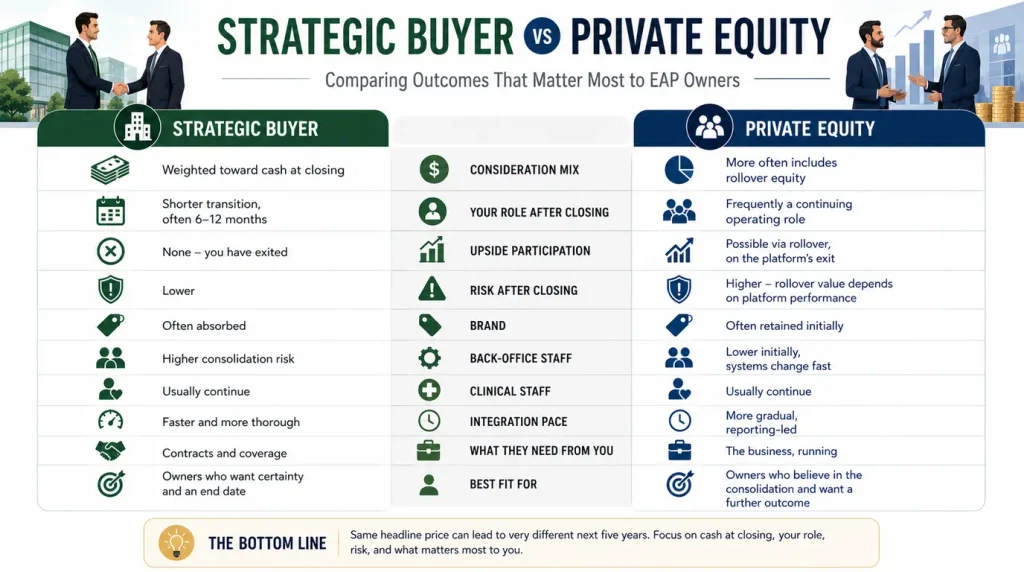
6. How much integration disruption can the business absorb?
Strategic integration is faster and more thorough: systems migration, contract migration, process alignment, often within twelve to eighteen months. If your team is small and your systems are idiosyncratic, that’s a real operational load on people who are also serving clients.
Private equity change is usually more gradual but not lighter — monthly reporting, contract-level P&L, KPI dashboards and board packs land on a business that has never produced them, and the first six months can feel like a permanent audit.
Side by side
| Strategic buyer | Private equity platform | |
|---|---|---|
| Consideration mix | Weighted toward cash at close | More often includes rollover equity |
| Your role after | Shorter transition, often 6–12 months | Frequently a continuing operating role |
| Upside participation | None — you have exited | Possible via rollover, on the platform’s exit |
| Risk after closing | Lower | Higher — rollover value depends on platform performance |
| Brand | Often absorbed | Often retained initially |
| Back-office staff | Higher consolidation risk | Lower initially, systems change fast |
| Clinical staff | Usually continue | Usually continue |
| Integration pace | Faster and more thorough | More gradual, reporting-led |
| What they need from you | Contracts and coverage | The business, running |
| Best fit for | Owners who want certainty and an end date | Owners who believe in the consolidation and want a further outcome |
Illustrative framework — not transaction guidance.
What about payers and digital platforms?
The strategic-versus-sponsor framing covers most EAP transactions, but two other buyer types appear often enough to mention, and both behave slightly differently from a classic strategic buyer.
Health plans, payers and third-party administrators buy behavioral benefits capability to sit alongside employer relationships they already hold. Structurally they behave like a strategic buyer — cash-weighted, integration-focused, brand absorbed — but the absorption tends to be more complete, because the EAP becomes a component of a broader benefits product rather than a service line in its own right. Owners for whom the identity of the business matters should press hard on this before exclusivity.
Digital and tech-enabled mental health platforms buy employer distribution and clinical network. They also behave like a strategic buyer on consideration, but the post-close change is different in kind: the service itself may be repositioned around their product, with delivery shifting toward digital-first pathways. If your differentiation is a particular clinical model, ask specifically whether it survives.
Both are covered in full in who buys EAP companies.
How to run both types in the same process
You do not have to choose the buyer type in advance, and generally you should not.
A well-run process approaches strategics and sponsors concurrently, because they price differently and you cannot know in advance which will value your particular business most highly. A strategic buyer with a specific geographic gap may pay well above a sponsor’s model. A sponsor building a platform may pay well above a strategic with no urgent need.
Two practical points. First, the materials work for both — the same contract quality, renewal evidence and clinical documentation matter to each, so preparation is not buyer-specific. Second, comparing offers across the two types requires comparing cash at closing and total contingent consideration separately, never headline numbers. A strategic offer that is 90% cash and a sponsor offer at the same headline with 40% in rollover and earnout are not the same deal, and putting them side by side on price alone is how owners talk themselves into the wrong structure.
The third option nobody offers you
Worth saying because neither buyer will raise it: you can decline both.
Staying independent is a legitimate strategy, not a failure to transact, and it works where you have something a platform structurally cannot replicate — deep sector or regional specialty, a clinical model employers actively choose, direct employer relationships that don’t run through brokers, or genuine cost discipline at your scale.
It gets expensive when your largest employers start requiring capabilities you can’t fund, when broker channels concentrate around shorter approved-vendor lists, or when you are the succession plan and there’s nobody behind you. Pillar 5 works through that decision properly.
The point is that “which buyer” is the second question. The first is whether you want to sell at all, and answering it under offer pressure from either a strategic buyer or a sponsor is the wrong time to be deciding.
The mistake owners make comparing offers
One pattern is common enough to name.
An owner receives a strategic buyer offer and a sponsor offer, lays them side by side, and compares the headline numbers. The sponsor’s is higher. They proceed with the sponsor.
Six months later they hold less cash than the strategic buyer would have paid at closing, plus a rollover stake with a five-year horizon and an earnout tied to a metric they no longer control. Nothing improper happened. The offers were simply not comparable, and nobody built the comparison properly.
The comparison that works puts three numbers side by side for each offer: cash at closing net of escrow, total contingent consideration with its conditions written out, and the value of your time over the required post-close period. That third number is real and owners routinely score it at zero. Four years of continuing operating work at a below-market salary is a genuine cost, and it belongs in the comparison.
Do that arithmetic and the offers often reorder. Sometimes the strategic buyer’s lower headline is the better deal by a wide margin. Sometimes the sponsor’s rollover genuinely is worth the risk. What matters is that the answer comes from the arithmetic rather than from which conversation felt more flattering.
What to ask before exclusivity
Ask both types the same four things, and compare the specificity of the answers rather than the warmth.
- What happens to our employer contracts at the first renewal after close? Strategics usually migrate to their paper. That’s the moment your clients notice a change, and it’s what an earnout often sits on top of.
- What is your integration plan for clinical delivery, specifically? Not reassurance. A plan.
- What does month twelve look like for me personally, and is that documented?
- Which of my contracts do you consider at risk, and why? The most revealing question you can ask. A buyer who has done the work will have a view, and their answer tells you exactly where the holdbacks are going.
None of these is aggressive. All four get harder to ask once exclusivity is signed, because at that point you’re asking rather than negotiating.
One more thing worth doing, and almost nobody does it: ask both buyers for a reference. Specifically, ask to speak with a founder who sold them a business two or three years ago. A strategic buyer with a good integration record will offer this readily. A sponsor who has treated management well will have several names. Reluctance is not proof of anything, but willingness tells you a great deal, and a twenty-minute call with someone who has already lived the outcome you are contemplating is the cheapest diligence available to you.
Whichever way you lean, decide it on the arithmetic and the documented answers rather than on which meeting felt better. The full buyer landscape is in who buys EAP companies. Owners weighing a live approach from either type of buyer often find it useful to understand their own position before responding — specialist sell-side firms including Olympic M&A have those conversations well ahead of a process.
Frequently asked questions
Should I sell my EAP company to a strategic or private equity buyer?
Neither is inherently better. A strategic buyer typically weights consideration toward cash at close with a shorter transition and higher back-office consolidation. A private equity platform more often includes rollover equity and a continuing operating role, offering possible future upside at higher risk.
What is a strategic buyer?
A strategic buyer is an operating company in the same or an adjacent sector acquiring a business for commercial reasons — contracted revenue, geographic coverage, sector specialty or network density — rather than as a financial investment. In EAP, strategics are typically established EAP or behavioral benefits groups.
What is the difference between a strategic and a financial buyer?
A strategic buyer already operates in the sector and integrates the acquisition into an existing business, so it does not need the target’s infrastructure. A financial buyer, typically private equity, acquires the business as an investment, needs it to keep operating, and usually seeks an exit within a defined hold period.
Does a strategic buyer pay more than private equity?
Not reliably. Strategics can sometimes justify more because of synergies, while sponsors may structure more of the price as contingent or rollover. Comparing headline numbers across the two is misleading; the meaningful comparison is cash at closing against total contingent consideration and the conditions attached.
Will a strategic buyer keep my brand?
Usually not long term. Strategic acquisitions commonly absorb the acquired brand and migrate contracts to the acquirer’s paper at renewal. Private equity platforms more often retain the brand initially, though sponsors assembling several regional businesses typically consolidate branding eventually.
What happens to my staff with a strategic buyer?
Clinical delivery staff usually continue, since the acquirer needs the capability to service acquired contracts. Back-office functions such as finance, HR, billing and IT face higher consolidation risk than in a private equity deal, because the strategic buyer already operates those functions at scale.