
Almost nobody loses money selling your EAP business the way owners fear — through some dramatic act of bad faith by a buyer, discovered too late.
What actually happens is quieter. A series of small, reasonable-seeming decisions, each defensible on its own, that together hand away leverage the seller never gets back. By the time the cost shows up, it looks like market conditions rather than a choice made in month one.
These are the seven that recur when selling your EAP business, in rough order of what they cost. Every one of them is avoidable, and most are avoidable months before a transaction exists — which is the useful thing to know if selling your EAP business is still theoretical for you.
The pattern behind every expensive mistake when selling your EAP business
Before the list, the thing they have in common.
Selling an employee assistance program (EAP) business is an information game played between someone doing it once and someone doing it routinely. The buyer knows what a normal working capital peg looks like. They know what happens to an earnout when the metric isn’t defined tightly. They have seen four hundred contract files.
You have seen one.
Every mistake below is a version of the same failure: giving away information or optionality before you understood what it was worth. Which is why the fix is almost never “negotiate harder.” It’s “know sooner.”
Mistake 1 — Negotiating an unsolicited offer alone
Someone calls. They’re complimentary, specific about your business in a way that suggests real homework, and they’d rather keep things simple than run “some big auction process.” They name a number that is higher than you expected.
This feels like luck. It is efficiency, and the efficiency is theirs. It is also, by some distance, the most common way owners lose value selling your EAP business without ever knowing it happened.
A buyer who reaches you before you’ve tested the market has removed competition at no cost. They now set the price, the structure and the pace, and they’ll frame every subsequent concession as reasonable because there’s nothing to compare it to. Consolidation in this sector is active and well-capitalized — TELUS, for example, reported Workplace Options among its 2025 business acquisitions (TELUS Corp, Form 6-K, filed 2026) — and the firms doing this have processes for finding owners before those owners are ready.
What it costs. Rarely the headline number, which is often genuinely fair. Usually the structure: more of the price contingent, a longer earnout, a bigger escrow, a working capital definition you didn’t understand. All the places money hides.
What to do instead. Take the call — always take the call, it’s free information about how the market sees you. Be warm, be vague about timing, and give them nothing on financials. Then do not sign anything containing exclusivity until you know what else is out there. If the interest is real, it survives a few months. If it doesn’t survive a few months, it wasn’t the deal you thought it was.
Mistake 2 — Running a process with one buyer in it
This is the previous mistake’s consequence, and it deserves its own line because owners underestimate how completely it changes the dynamic.
Without an alternative, you have no information about value and no leverage over terms. Selling your EAP business into a single-buyer process is not a negotiation; it is an acceptance. Every deal point is conceded from the same position: agree, or start again from nothing after months of work. Buyers know exactly where you sit, because they’ve watched it from the other side many times.
A competitive process isn’t about manufacturing a bidding frenzy. Most EAP transactions don’t have one, and the buyer universe in this niche isn’t large. It’s about establishing what the business is worth to the market rather than what one party says it’s worth to them. Those are different numbers, and only the first is information.
What it costs. In our transaction experience, more in structure than in price. The concessions that hurt aren’t dramatic — they’re a two-year earnout instead of one, a metric defined loosely, an exclusivity period that extends automatically.
Mistake 3 — Presenting numbers you can’t defend
You have thirty add-backs. Twenty-six have invoices behind them. Four are things you’re fairly sure about but can’t document.
The temptation is obvious: include all thirty, and if a few get questioned, you’ve lost nothing. It is, when selling your EAP business, an unusually expensive piece of optimism.
That is not how it works, and it is one of the quieter ways selling your EAP business goes sideways. One unsupported add-back is arithmetic. Three is a pattern, and once a diligence provider identifies a pattern, they stop taking your numbers at face value and start testing everything. The four soft add-backs don’t cost you four add-backs. They cost you the credibility of the other twenty-six.
What to do instead. Build the schedule with evidence attached and delete anything you can’t support, before anyone asks. A smaller, bulletproof adjusted EBITDA outperforms a larger fragile one, because it’s the surviving number that gets multiplied. This is one of the first tasks in EAP exit planning, and it’s free.
The same principle covers everything you say in a management meeting. If your technology is basic, say it’s basic and explain why it works for your book. Overselling gets found in week two of EAP due diligence, and then everything else you said gets re-read.
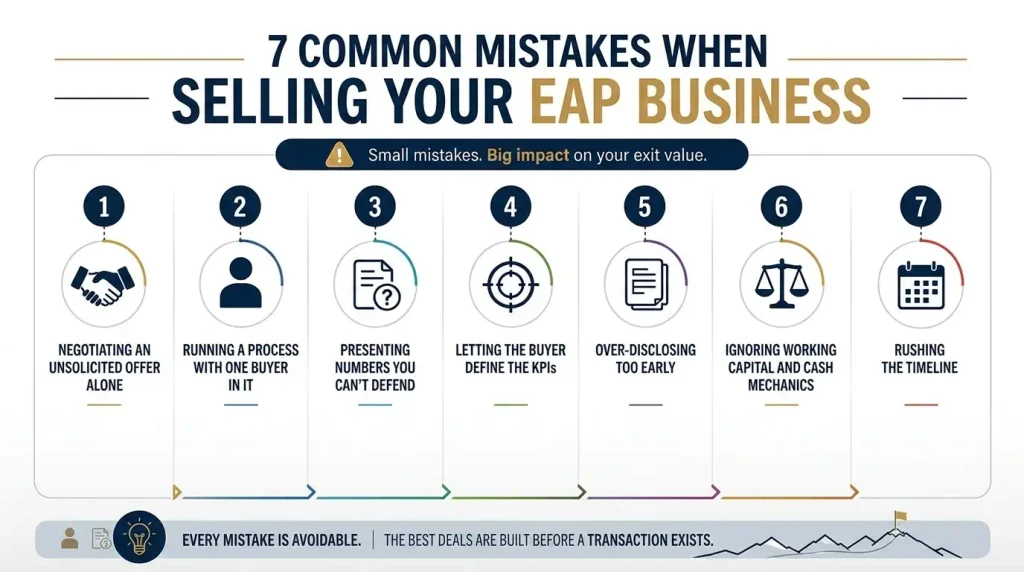
Mistake 4 — Leaving concentration to be discovered
Your largest employer is a substantial share of revenue. You know it. You’ve made peace with it — the relationship is twenty years old, the renewal has never been in doubt, and the client would tell you if anything changed.
None of that survives a spreadsheet. Concentration is the single most-modelled risk when someone is buying an EAP book.
The buyer will calculate concentration themselves, across three years, and they’ll look at the trend. What they cannot do is share your confidence, because their confidence would have to be in a relationship they don’t have with a person they’ve never met.
What it costs. Concentration rarely kills a transaction. It reshapes one. The concentrated revenue gets carved out of what you receive at closing and attached to an earnout tied to that specific contract renewing, or covered by a specific indemnity. You still get paid — later, and only if things go the way everyone expects.
What to do instead. Measure it early and start diluting it, which takes quarters. Then, when it comes up, raise it yourself with the numbers and the plan. An owner who segments their own weakness is more credible than one who presents a uniformly excellent business that turns out not to be.
Mistake 5 — Letting a big renewal land mid-process
This one is pure sequencing, and it’s the most fixable item on the list. It is also the mistake owners are most surprised by, because nothing about selling your EAP business feels like it should hinge on a calendar.
Renewals during diligence get watched with an intensity that’s hard to overstate. A major client moving to a short-term extension in month three, for entirely ordinary reasons on their side, will change the shape of your deal. It doesn’t matter that they renewed every year for a decade. What matters is that the buyer now has evidence of uncertainty in the exact revenue they’re underwriting.
What to do instead. Map your renewal calendar before you plan a process, and sequence the big ones ahead of it. If a major renewal falls inside your likely diligence window, either bring it forward or accept that your timing needs to move. This costs nothing except planning, and it’s the item owners most often overlook while worrying about valuation.
Mistake 6 — Telling people too early
Of all the judgment calls involved in selling your EAP business, this is the one owners get wrong for the best reasons.
The instinct comes from decency. These people built the company with you, and keeping something this significant from them feels like a betrayal.
It’s still usually the wrong call.
A sale that becomes known before it’s certain creates months of anxiety about an event that may never happen. In a business where employer relationships are held personally and clinical staff are mobile, that anxiety has commercial consequences: account managers start taking recruiter calls, affiliates hedge, and a client who hears a rumor from a nervous counselor asks questions you cannot answer honestly. The resulting wobble reduces the price that would have funded the outcome you wanted for those staff in the first place.
What to do instead. A very small circle under NDA during the process — usually the finance lead and one operational deputy. A communication plan agreed with the buyer before signing. Then tell the wider team at or immediately after signing, in person, from you. The thing that damages trust isn’t finding out late. It’s finding out sideways.
Mistake 7 — Having no answer about staff
Related, and different. Mistake 6 is about timing. This one is about not having thought it through at all, and it is where selling your EAP business collides hardest with why you built it.
When selling your EAP business, the question that stalls more processes than valuation does is what happens to the counselors. Owners raise it late, emotionally, and without leverage, usually somewhere in month three of diligence when it’s a request rather than a term.
Here’s the thing owners don’t realize: you have far more influence over this than you think, and almost all of it is before the letter of intent.
Clinical delivery is usually a substantial part of what’s being bought. A buyer who dismantles the network has purchased a contract book they can’t service. Back-office functions — finance, HR, billing, IT — are more often consolidated, particularly in add-on acquisitions where the acquirer already runs them at scale. That’s the honest picture, and it’s stable enough to plan around.
What to do instead. Ask directly, before exclusivity: what’s your integration plan for clinical delivery, and what happens to our account management team? Notice whether the answer is specific. Then negotiate what matters to you as a deal term — retention arrangements for key clinical staff, a defined transition period, commitments on the affiliate network. Buyers who intend continuity are generally willing to document it. Buyers who won’t document it have told you something.
Raised at LOI stage, these are ordinary negotiating points. Raised in month three, they’re a favor you’re asking of someone who no longer needs to grant it.
The four questions that prevent most of this
If you take one thing from the list, make it these. Ask them before signing anything with exclusivity in it, and most of the seven mistakes above stop being available to you.
“Who else have you looked at in this space?” A buyer’s answer tells you whether you’re a strategic priority or a convenient one. It also tells you, indirectly, whether they’ve already filled the geography or specialty you thought made you distinctive. Nobody is obliged to answer honestly, but the shape of the answer is informative.
“What exactly is contingent, and on what?” Ask for the price split in writing before the letter of intent: cash at close, escrow, earnout, rollover, seller note. Then ask how each contingent element is measured. Selling your EAP business on a headline number without this breakdown is the most common way owners discover, months later, that the deal they agreed to isn’t the deal they’re in.
“What is your integration plan for clinical delivery?” Covered above, and worth repeating because the timing is everything. Ask it early, listen for specificity, and get the answer documented if it matters to you.
“How long is exclusivity, and does it extend automatically?” Exclusivity is the buyer’s single most valuable ask and the one owners give away most cheaply. Automatic extensions are worth resisting hard. Every additional week is a week in which your only remaining leverage is a willingness to abandon months of work.
None of those four is aggressive. They’re the questions a reasonable person asks about a significant transaction, and a buyer who bristles at any of them has given you useful information at no cost.
Selling your EAP business well is mostly this: asking ordinary questions earlier than feels necessary, and writing the answers down.
The pattern across all seven: the expensive moment is almost never the moment it feels expensive. It’s months earlier, in a decision that seemed small. That is the whole argument for treating selling your EAP business as a two-year discipline rather than a six-month event.
Which is the argument for treating the sale as something you prepare for over two years rather than execute over six months. Nobody negotiates their way out of a weak position; they only avoid arriving in one. The complete guide to selling an EAP business sets out the full sequence, and owners who want to pressure-test their position before deciding anything will find that specialist sell-side firms including Olympic M&A have those conversations years ahead of a process, with nothing attached.
Frequently asked questions
What are the most common mistakes when selling your EAP business?
The most costly errors are negotiating an unsolicited offer without alternatives, running a single-buyer process, presenting unsupported add-backs, leaving client concentration to be discovered in diligence, allowing a major renewal to fall mid-process, disclosing the sale internally too early, and having no negotiated position on staff.
Should I accept an unsolicited offer for my EAP company?
Not without independent context. An unsolicited approach establishes that one buyer is interested, not what the business is worth. Take the call and share nothing on financials, but avoid signing anything containing exclusivity until you understand the wider market. Genuine interest survives a few months.
What happens to staff when an EAP company is sold?
Clinical delivery staff and affiliate networks usually continue, because a buyer acquiring contracted employer revenue needs the capability to service it. Back-office functions such as finance, HR, billing and IT are more often consolidated, particularly in add-on acquisitions where the acquirer already operates them at scale.
When should I tell my team I am selling?
Generally at or immediately after signing, with a small circle under NDA during the process and a communication plan agreed with the buyer beforehand. Early disclosure creates months of anxiety over an uncertain event and, in a relationship-held business, creates genuine commercial risk.
Can I negotiate protections for my staff in a sale?
Yes, and the time to do it is before granting exclusivity. Retention arrangements for key clinical staff, defined transition periods and commitments on the affiliate network are ordinary deal terms. Once exclusivity is signed, the same requests become favors rather than negotiating points.
What are the biggest red flags in an EAP deal?
Warning signs include exclusivity periods with automatic extensions, earnout metrics left undefined, working capital definitions that omit deferred revenue treatment, reluctance to document integration commitments, and any pressure to move quickly on the basis that a window is closing.