
Somewhere in the offer, a sentence explains that thirty percent of your consideration will be reinvested into the acquiring entity.
It rarely gets much discussion, and it should. It’s usually presented as alignment — evidence that the sponsor wants you invested in what comes next — and it feels like a compliment rather than a term. Most employee assistance program (EAP) owners spend far more time negotiating the headline number than they spend on rollover equity, despite the fact that the rollover often represents a larger share of their eventual outcome.
Here’s the thing to internalize before anything else: rollover equity is not a payment term. It is an investment decision, made with post-tax proceeds, into a private, illiquid, leveraged company you will not control.
The money doesn’t reach your account. That doesn’t mean you didn’t spend it.
What rollover equity actually is
Rollover equity is the portion of your sale proceeds reinvested into the acquiring entity rather than taken as cash, giving you a minority stake that is realized only if that entity is later sold. It appears mainly in private equity platform transactions, where the sponsor wants the founder financially aligned with the consolidation they’re building.
Strategic buyers rarely ask for it — they’re purchasing a business, not recruiting a partner. That difference is one of the clearest practical distinctions between the two buyer types, covered in strategic buyer or private equity.
Rollover equity is sold on one idea: the “second bite of the apple.” Your stake participates in the platform’s eventual exit, at the platform’s exit multiple rather than yours. If the sponsor assembles several EAP books, professionalizes them, and sells the group at a stronger multiple than any individual business would have achieved, your minority stake benefits from that arbitrage.
That does happen, and it happens often enough to be worth taking seriously. Sponsors hold sector assets for long periods and build genuine value — Stone Point Capital, for instance, lists ComPsych as a portfolio company with an investment year of 2017 at buyout stage (Stone Point Capital, accessed August 2026), which is a substantial hold in this sector.
It also sometimes doesn’t happen. Both outcomes are real, and the seven questions below are how you tell which one you’re being offered.
The seven questions
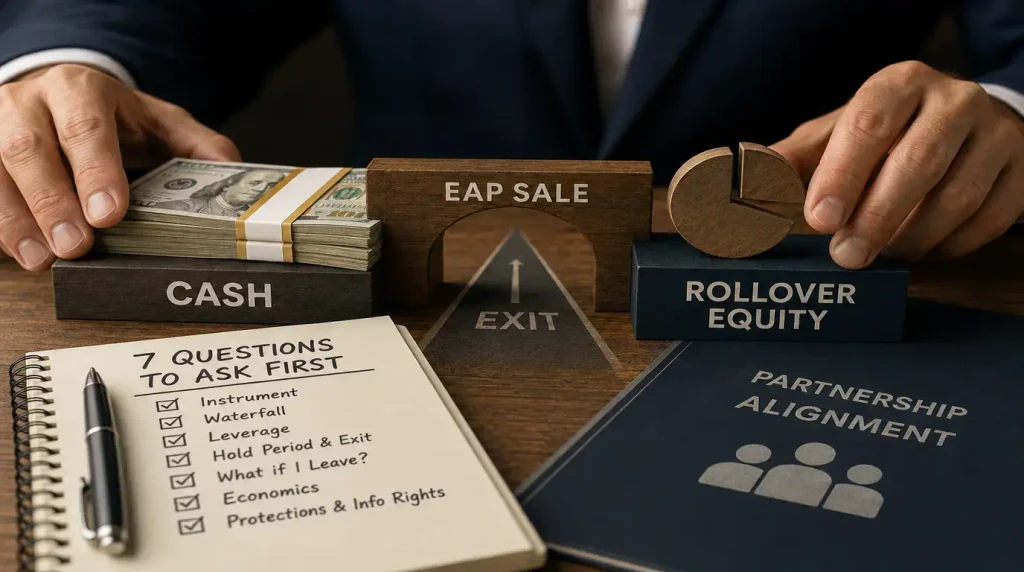
1. What instrument am I actually holding?
The most important question, and the one asked least.
Sponsors typically hold preferred equity carrying a liquidation preference and often a compounding return hurdle. If your rollover equity is common equity sitting behind that preference, the proceeds waterfall pays the sponsor’s preferred position in full — plus its accrued return — before your common shares receive anything.
In a strong exit that ranking barely matters. In a mediocre one it can be the entire difference between a meaningful second payment and a nominal one.
What to ask for: rolling into the same instrument the sponsor holds, on the same terms, pro rata. Sometimes called “strip” equity. You will not always get it. Asking establishes immediately whether you’re being treated as a partner or as a source of financing.
2. Where does it rank in the waterfall?
Related but distinct. Even within a preferred structure, there can be multiple layers, and there is often debt sitting above all of it.
Ask for the full capital structure and a worked example of the exit waterfall at three scenarios — a poor exit, a base case, and a strong one — showing what your stake returns in each. A sponsor who has modeled the deal has this already. Reluctance to share it is informative.
3. How much leverage sits on the platform?
Debt is repaid before equity sees anything, which means leverage amplifies your outcome in both directions.
A modestly leveraged platform produces steadier, less dramatic returns. A heavily leveraged one can produce excellent returns in a good scenario and wipe out common equity in a bad one. Neither is wrong; you simply need to know which you’re in, because it determines how much of your retirement you should be putting into it.
4. What is the hold period and exit route?
Rollover equity has no exit of its own; it exits when the sponsor does.
Rollover equity is illiquid until the sponsor exits. Ask when they expect that to be, and how — a sale to a larger sponsor, a strategic acquirer, a recapitalization.
Then add two years to whatever they say. Hold periods extend routinely, for reasons ranging from market conditions to the platform needing more time. If you would find a seven-year wait genuinely difficult, size your rollover for a seven-year wait rather than the five you were told.
5. What happens to my stake if I leave?
Good leaver and bad leaver provisions govern this, and they are negotiated at the outset and essentially never revisited.
The questions that matter: what circumstances make me a bad leaver, what happens to my stake in each case, and is there a valuation mechanism or is it a formula? “Bad leaver” definitions that include resignation without a long notice period effectively lock you into an operating role for years, which may be fine — but you should know you’re agreeing to it.
Ask specifically about death and incapacity. Owners find this conversation uncomfortable and it is far more uncomfortable for a family dealing with an ambiguous clause later.
6. What rights do I have on a subsequent sale?
Tag-along rights let you sell alongside the sponsor on the same terms when they exit. Without them, in principle, they can sell their position and leave you holding a minority stake in a company now owned by someone you never met.
Drag-along rights work the other way and compel you to sell. These are normal and usually acceptable, provided the terms are the same as the sponsor’s.
Information rights determine whether you receive accounts, board papers and valuation updates during the hold, or whether you find out how your investment is performing from occasional conversation.
Ask for all three explicitly.
7. Could I afford this to be worth zero?
The question that settles the percentage.
If the honest answer is no, the rollover is too large, regardless of how compelling the projections look. This is retirement capital going into a single illiquid private company in one narrow sector — a concentration of risk no financial adviser would recommend if you described it in the abstract.
Nobody is suggesting rollover is a bad idea. Owners who rolled into well-run consolidations have done extremely well, and some have made more from the second bite than from the first. The suggestion is narrower: size the rollover as an investment decision on its own merits, rather than accepting whatever percentage happened to be in the offer because it arrived attached to a number you liked.
The waterfall, explained plainly
When the platform is eventually sold, proceeds are distributed in a defined order.
| Order | Who gets paid | Notes |
|---|---|---|
| 1 | Transaction costs | Advisory, legal, accounting fees on the exit |
| 2 | Debt | All borrowings repaid in full, with accrued interest |
| 3 | Preferred equity | Sponsor’s position, plus any accrued or compounding return |
| 4 | Common equity | Split pro rata — where seller rollover often sits |
| 5 | Management incentive plan | Sometimes carved out ahead of common, sometimes alongside |
Illustrative structure — actual waterfalls vary by transaction and are governed by the shareholders’ agreement.
Read that table with your own rollover in mind and one thing becomes obvious: your position in the order matters more than the size of your percentage. Two percent of a strip that ranks with the sponsor can be worth considerably more than five percent of common sitting behind a preference with an accruing hurdle.
This is precisely why question one is question one.
What the second bite looks like when it works
A founder rolls a meaningful stake into a sponsor-backed platform. Over five years the platform acquires four more regional books, consolidates onto one case management system, professionalizes reporting, and grows organically alongside. It sells to a larger strategic acquirer at a stronger multiple than any of the constituent businesses would have achieved alone.
The founder’s rollover equity is realized at that exit, and the second payment materially exceeds what they would have received had they taken all cash at the outset. They also spent five years building something larger than they could have built alone, which some owners find genuinely rewarding.
This happens. It is the reason rollover exists as a structure, and it’s why blanket advice to refuse it is bad advice.
What it looks like when it doesn’t
The same founder rolls the same stake. The platform makes two acquisitions that integrate poorly. A large employer contract at one of the acquired businesses doesn’t renew. The sponsor’s exit slips from year five to year eight while they work on margin. When the sale finally happens, proceeds clear the debt and the preferred position with its accrued return, and the common equity receives a fraction of what the model showed.
Nothing improper occurred. The business simply underperformed, and the founder’s position in the waterfall meant they absorbed that underperformance first.
The founder is also eight years older, and the capital they might have deployed elsewhere was locked up throughout.
Neither story is more likely than the other in the abstract. Which one you’re closer to depends on the sponsor’s track record, the leverage, the instrument, and the quality of the businesses being assembled — which is why diligencing the sponsor matters as much as diligencing the terms. The private equity thesis piece covers what to ask about the sponsor themselves.
Rollover in a platform deal versus an add-on
The same word covers two quite different propositions, and owners are rarely told which one they’re in.
In a platform deal, you are the base the sponsor is building on. Rollover percentages tend to be larger, the sponsor genuinely needs you engaged, and your influence over how the platform develops is real even though it is shared. You are also exposed to the performance of businesses that haven’t been acquired yet — the four books bought after you, whose integration you may have limited control over.
In an add-on, you are joining a platform that already exists and already has a track record you can examine. Rollover equity here is usually a smaller percentage, your influence is limited, and your role is shorter. The compensating advantage is substantial: you can diligence what you’re investing into. The platform has financials, a management team, an acquisition record and a set of prior sellers you could speak to.
That asymmetry is worth using. An add-on rollover is a far more assessable investment than a platform rollover, because in a platform deal you are investing in a plan rather than a company.
The practical implication for a platform seller is to weight your assessment toward the sponsor rather than the assets — their sector record, their hold discipline, how they’ve treated management in prior deals, and how many of those deals produced a good outcome for the founders. The private equity thesis piece sets out what to ask.
And in both cases, ask to speak with a founder who rolled equity with this sponsor two or three years ago. A sponsor who has treated management well will have names. Twenty minutes with someone living the outcome you’re contemplating is the cheapest diligence available to you, and almost nobody asks for it.
How much is too much
There’s no universal answer, but there is a workable test.
Take the cash you would receive at closing, net of escrow and any earnout, and ask whether that number alone represents an acceptable outcome for the business you built. If it does, the rollover is genuine upside and you can size it by how much you believe in the platform. If it doesn’t — if the deal only works assuming the second bite pays — you are not selling your business. You are exchanging it for a minority stake in someone else’s plan, plus a deposit.
That test cuts through most of the emotional weight around the decision, and it’s worth applying before you get attached to a headline number that includes contingent and rollover components. The related question of how contingent consideration behaves is in EAP earnouts, and the full breakdown of how a price divides across cash, escrow, earnout and rollover equity is in the deal structures pillar.
Owners weighing a rollover proposal for the first time will find that specialist sell-side firms including Olympic M&A work through the instrument, ranking and leaver terms with owners before an offer is signed — which is the only point at which any of it is negotiable.
Frequently asked questions
What is rollover equity in an EAP sale?
Rollover equity is the portion of sale proceeds reinvested into the acquiring entity rather than taken as cash, giving the seller a minority stake realized only when that entity is later sold. It appears mainly in private equity platform transactions and is intended to align the founder with the consolidation.
Is rollover equity part of the purchase price?
Functionally it is an investment decision rather than a payment. The consideration is reinvested into a private, illiquid, leveraged company the seller does not control. The fact that the money never reaches the seller’s account does not change what it is or the risk attached.
What is a second bite of the apple?
The second bite is the payment a seller receives when rollover equity is realized on the acquiring platform’s eventual exit. Because platforms often trade at stronger multiples than individual businesses, the second payment can exceed what the seller would have received in an all-cash deal.
What should I ask before agreeing to rollover equity?
Ask what instrument you hold, where it ranks in the exit waterfall, how much leverage sits on the platform, the intended hold period and exit route, what happens to your stake if you leave, whether you have tag-along and information rights, and whether you could afford the stake to be worth nothing.
What is an exit waterfall?
An exit waterfall is the order in which sale proceeds are distributed: transaction costs, then debt, then preferred equity including any accrued return, then common equity, with management incentive plans carved out depending on the structure. Seller rollover commonly sits in the common equity layer.
How much rollover equity should I accept?
Size it so that the cash received at closing, net of escrow and earnout, already represents an acceptable outcome on its own. If the deal only works assuming the rollover pays out, the rollover is too large. Treat it as concentrated investment risk, not as consideration.