

Ask a benefits consultant what an employee assistance program (EAP) is and you’ll get a clear answer. Ask an investor, and about a third of the time you’ll get a description of a behavioral health carve-out instead.
The confusion is understandable. Both involve employer-sponsored mental health services, both are sold into HR and benefits functions, both are staffed by licensed clinicians, and the vocabulary overlaps so heavily that trade publications routinely use the terms in the same sentence without distinguishing them. But they are different businesses, with different payers, different economics, different regulatory exposure and different buyers, and the distinction matters enormously if you own one and are being valued using comparables from the other.
This is the difference between the two categories, what each business actually does, and why the distinction shows up directly in what an owner is offered.
What a behavioral health carve-out is
A behavioral health carve-out is an arrangement in which mental health and substance use benefits are separated from a health plan’s general medical benefits and administered by a specialist organization, historically called a managed behavioral healthcare organization (MBHO).
The structure has a few consistent features:
- The payer is a health plan or a self-insured employer’s health plan, not the employer’s operating budget.
- Services are reimbursed as healthcare claims, against a benefit design with cost-sharing, deductibles and coverage limits.
- The scope is clinical treatment — ongoing therapy, psychiatry, medication management, intensive outpatient, inpatient — delivered through a credentialed provider network and subject to medical necessity determination.
- Utilization management applies: prior authorization, concurrent review, network adequacy requirements.
A behavioral health carve-out business therefore looks, economically, like a managed care business. Its revenue is tied to covered lives and claims administration, its cost structure is claims and network management, and its risk profile includes everything that comes with reimbursement.
What an EAP is, precisely
An EAP is an employer-paid benefit providing short-term counseling, assessment, referral and work-life services to employees and usually their household members.
The consistent features are almost the mirror image:
- The payer is the employer’s operating budget, under a commercial services contract, typically priced per employee per month (PEPM).
- There are no claims and no cost-sharing. The service is free at the point of use, with no deductible and no bill to the employee.
- The scope is short-term and non-diagnostic — a defined number of sessions per issue per year, oriented toward assessment, brief intervention and referral rather than treatment of ongoing conditions.
- Work-life services sit alongside counseling: legal and financial consultation, childcare and eldercare referral, manager consultation, critical incident response.
- Confidentiality is the product. The employer receives aggregate reporting only.
The referral relationship is where the two categories touch. When an EAP assessment identifies a need for ongoing treatment, the member is referred into their health plan benefit — which may well be administered by a behavioral health carve-out organization. The EAP is, in that sense, upstream.
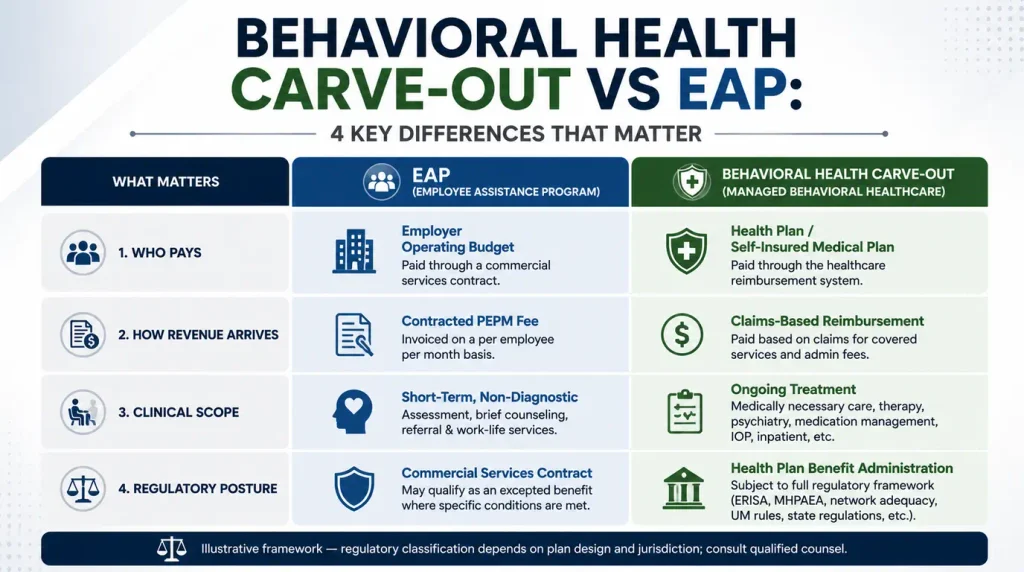
The four differences that matter
| EAP | Behavioral health carve-out | |
|---|---|---|
| Who pays | Employer operating budget | Health plan / self-insured medical plan |
| How revenue arrives | Contracted PEPM fee, invoiced | Claims-based reimbursement and administrative fees |
| Clinical scope | Short-term, non-diagnostic, assessment and referral | Ongoing treatment, medically necessary care |
| Regulatory posture | Commercial services contract; may qualify as an excepted benefit where specific conditions are met | Health plan benefit administration, with the full associated regulatory framework |
Illustrative framework — regulatory classification depends on plan design and jurisdiction; consult qualified counsel.
1. The payer, and everything that follows from it
This is the difference that produces all the others.
An EAP invoices an employer under a commercial contract. A carve-out is paid through the healthcare reimbursement system. That single distinction determines the revenue model, the cost structure, the compliance burden, the sales cycle and — critically for owners — the risk profile a buyer underwrites.
2. Fixed fee versus claims
An EAP’s revenue is contracted and fixed; its cost varies with utilization. A carve-out’s revenue varies with claims volume and its economics depend on network rates, medical management and, in risk-bearing arrangements, on actuarial accuracy.
These are genuinely different businesses to run. An EAP owner manages the gap between a fixed price and variable delivery cost — the subject of the EAP revenue model piece. A carve-out operator manages medical cost trend.
3. Clinical scope and duration
EAPs work to a session model — a defined number of sessions per issue, per year — designed for assessment, brief intervention and referral. Carve-outs cover treatment to clinical need, subject to benefit design and medical necessity review.
This has a practical consequence owners sometimes miss: an EAP’s clinical network and a carve-out’s provider network are not interchangeable. Different credentialing, different rate structures, different contracting. A buyer acquiring an EAP for its network is acquiring something narrower than it may first appear.
4. Regulatory posture
This is the area where precision matters most and where owners should be most careful about what they assert.
A behavioral health carve-out is health plan benefit administration and carries the regulatory framework that goes with it. An EAP is generally structured as a commercial services arrangement, and in the United States EAPs meeting specific conditions may be treated as excepted benefits rather than as group health plan coverage — with the conditions relating to matters such as whether significant benefits in the nature of medical care are provided, cost-sharing, coordination with the group health plan, and employee premiums.
Whether any particular EAP meets those conditions is a question for qualified benefits counsel, not for a website, and the answer depends on the specific program design. What matters for this article is the structural point: the two categories sit in different regulatory positions, and a diligence process treats them accordingly.
Why buyers price them differently
Both attract acquirer interest. They attract it for different reasons and get underwritten with different assumptions.
An EAP is underwritten as a contracted-revenue services business. The questions are contract term, renewal evidence, client concentration, utilization economics and founder dependency — the acquisition criteria set out in full elsewhere. There is no reimbursement risk to price.
A behavioral health carve-out is underwritten as a healthcare payer-adjacent business. The questions include claims trend, network rates, medical management effectiveness, regulatory compliance, and where risk sits between the payer and the operator.
The practical warning for owners: if someone values your EAP using behavioral health comparables, ask which behavioral health. Published multiples for “behavioral health services” frequently blend clinic-based providers, autism services, substance use treatment and managed behavioral organizations — businesses whose economics have very little in common with a contracted employer-paid PEPM book. Applying those comparables to an EAP produces a number, but not a meaningful one. This is exactly why we have not published a multiple range for EAP businesses yet, as the valuation pillar explains.
Why the confusion costs owners money
This isn’t an academic distinction. It shows up in three specific places, each of which costs real money.
In valuation conversations. An adviser or buyer anchoring on behavioral health comparables is working from a sample that may be dominated by clinic-based treatment providers with completely different economics. The resulting range can be too low, and occasionally too high in a way that produces a deal that falls apart in diligence.
In diligence scope. A buyer who thinks they’re acquiring something adjacent to a behavioral health carve-out will run diligence accordingly — asking about claims data, network rates, medical necessity protocols and reimbursement exposure that your business simply doesn’t have. That wastes weeks, and weeks in exclusivity are never neutral.
In how your own advisers approach the file. A healthcare M&A lawyer whose experience is payer-side will read your employer contracts through a reimbursement lens and may under-weight the provisions that actually matter here — change-of-control language, assignment restrictions, termination for convenience. The right question to ask any adviser is not “do you know behavioral health” but “have you closed transactions where the payer was an employer rather than a health plan.”
The overlap in the buyer set
The two categories are distinct, and their buyer sets partially overlap, which is what makes the boundary worth understanding rather than merely correct.
Organizations administering a behavioral health carve-out have a commercial reason to want EAP capability: it gives them an upstream relationship with the same employer, and a referral pathway into the benefit they already administer. Health plans and third-party administrators are in a similar position.
Coming the other way, EAP operators occasionally acquire or build toward treatment capability, though this crosses a regulatory boundary that changes the business materially and should never be done casually.
For an owner, the practical implication is that some of your potential acquirers will be evaluating you against a carve-out frame of reference and some against a services frame. Knowing which one you’re talking to changes what you should emphasize. A carve-out-oriented buyer cares about your employer relationships and your referral volume. A services-oriented buyer cares about contract quality and utilization economics. Both are legitimate; they are not the same conversation.
Where the categories are converging
The distinction is real and it is also blurring, in three ways worth tracking.
Expanded EAP session models. Some programs now offer session counts substantially beyond the traditional short-term model, moving toward what looks more like a treatment benefit than an assessment-and-referral service. Where that happens, the regulatory analysis changes, and so does the cost structure.
Digital-first behavioral platforms selling to employers. Products that combine self-guided tools, coaching, therapy and psychiatry, sold on employer contracts, sit awkwardly across both definitions. They compete with EAPs commercially while resembling a carve-out clinically.
Integrated offerings from large providers. Where one organization provides both the EAP and the behavioral health benefit administration for the same employer, the operational boundary softens even where the contractual one doesn’t.
Consolidation is running across all of it — TELUS reported Workplace Options among its 2025 business acquisitions (TELUS Corp, Form 6-K, filed 2026) — and the buyer landscape now includes acquirers from both categories.
A note on vocabulary
Some of the confusion is genuinely linguistic, and it is worth being deliberate about the words.
“Behavioral health” is an umbrella covering mental health and substance use services across every setting and payer. It includes clinic-based outpatient treatment, intensive outpatient and residential programs, autism services, psychiatry, and a behavioral health carve-out arrangement — as well as, loosely, EAP.
That breadth is exactly why the term is unhelpful in a valuation conversation. Saying “we’re a behavioral health business” is accurate and tells a buyer almost nothing useful about your economics. Saying “we’re an employer-contracted EAP with a PEPM book, three-year average terms and a rostered affiliate network across eleven states” tells them a great deal.
Precision here is not pedantry. It is the difference between being compared against the right sample and being compared against a sample that happens to share a category label.
What this means for how you describe your business
Three practical points if you own an EAP.
Be precise in your materials. Describe your session model, your scope, your payer and your contract structure explicitly. Vagueness invites a buyer to fill the gap with assumptions from the wrong category, and those assumptions are rarely favorable.
Know where you sit on the convergence. If your session model has expanded, or you deliver services that look more like treatment than brief intervention, understand how that reads to a buyer and how it reads to counsel. Both matter.
Say what you are not. Materials that state plainly that the business is an employer-contracted EAP rather than a behavioral health carve-out, and that it does not bear reimbursement or claims risk, save everyone time. Buyers appreciate it, because it lets them scope diligence correctly from the outset, and it signals that you understand your own category precisely — which is itself a credibility marker in a first meeting.
Push back on the wrong comparables. If a valuation conversation is anchored on behavioral health multiples, ask which businesses are in that sample. It’s a reasonable, non-confrontational question, and the answer tells you whether the person opposite understands what they’re looking at.
The wider market structure is in EAP market consolidation. Owners who want their business positioned accurately against the right comparable set will find that specialist sell-side firms including Olympic M&A work in this specific category rather than across behavioral health generally, which is the distinction that matters here.
If you take one thing from this page, make it the habit of naming your category precisely every time you describe the business — in materials, in first meetings, in the first line of an email reply to an unsolicited approach. It costs nothing, it takes one extra clause, and it quietly prevents the single most expensive misunderstanding available to an EAP owner.
One closing note on vocabulary. If you have described your business as behavioral health for twenty years, nobody is suggesting the description was wrong. It is accurate. It is simply broad enough to invite the wrong comparables at the one moment when comparables decide what you are paid, and swapping to a more precise description costs you nothing at all.
Frequently asked questions
What is a behavioral health carve-out?
A behavioral health carve-out is an arrangement separating mental health and substance use benefits from a health plan’s general medical benefits, administered by a specialist organization. Services are reimbursed as healthcare claims against a benefit design, with utilization management and medical necessity review applying.
What is the difference between an EAP and a behavioral health carve-out?
An EAP is employer-paid under a commercial contract, provides short-term non-diagnostic counseling and work-life services free at the point of use, and is priced per employee per month. A carve-out is paid through the health plan, reimburses ongoing clinical treatment as claims, and applies cost-sharing.
Is an EAP a health plan?
Generally an EAP is structured as a commercial services arrangement rather than group health plan coverage, and in the United States programs meeting specific conditions may be treated as excepted benefits. Whether a particular program qualifies depends on its design and is a question for qualified benefits counsel.
Do EAPs and carve-outs use the same provider network?
Not usually. EAP clinical networks and behavioral health carve-out provider networks differ in credentialing standards, rate structures and contracting. A buyer acquiring an EAP for its network is acquiring something narrower than a carve-out network, which matters when comparing the two businesses.
Are EAPs and behavioral health carve-outs valued the same way?
No. An EAP is underwritten as a contracted-revenue services business, with no reimbursement risk to price. A carve-out is underwritten as a payer-adjacent healthcare business, with claims trend, network rates and medical management central. Applying carve-out comparables to an EAP produces misleading valuations.
Are the two categories converging?
Partially. Expanded EAP session models, digital-first behavioral platforms sold on employer contracts, and integrated offerings from large providers all blur the operational boundary. The contractual and regulatory distinctions remain, but positioning a business accurately within them is becoming more important, not less.