

Most employee assistance program (EAP) owners start thinking seriously about a sale roughly four months before they want one. EAP exit planning done at that point is triage. It’s a list of things you now cannot fix, being handed to someone who is going to price every one of them.
The owners who do best are the ones who started two years earlier, usually for an unglamorous reason: they weren’t sure they wanted to sell at all, and they decided to get the business in shape while they made up their minds.
That is the whole trick, and it’s available to anyone reading this. Everything below costs time rather than money, none of it commits you to anything, and all of it makes the business better whether you sell in 2028 or never.
What EAP exit planning actually means
EAP exit planning is the work of making your business easy for someone else to own. Not more profitable, necessarily. Not bigger. Transferable.
That distinction matters because the two lists diverge more than owners expect. Some of what makes your EAP work brilliantly right now — your relationships with the three biggest employers, your personal read on which counselor to send a difficult case to, the fact that you can quote your own pricing from memory — is value locked inside a person. From a buyer’s seat, value locked inside a person walking out the door isn’t value. It’s risk.
So exit planning is mostly a process of getting things out of your head and into records, out of your hands and into other people’s, and out of habit and into contracts.
Nobody enjoys it. Everyone who does it is glad they did.
Why twenty-four months
Because the two things that move the number most both run on your clients’ calendar, not yours.
Contract terms change at renewal. If you want three-year agreements instead of rolling annuals, you get one shot per client per year. Over twenty-four months you can touch most of the book. Over four months you can touch whichever contracts happen to fall in that window, which is not a strategy.
Concentration dilutes slowly. If one employer is 40% of revenue, you fix that by growing the rest of the book, and growth in this market comes through broker cycles and procurement cycles that take quarters.
Everything else on the list is faster. But those two carry the most weight, and they set the clock. That’s why serious EAP exit planning starts two years out and why owners who begin at six months are working on the short list rather than the important one.
There’s a second reason, less about mechanics. Two years is long enough that you’re making decisions calmly. Four months is long enough to make decisions under pressure, which is exactly the condition buyers do their best work in.
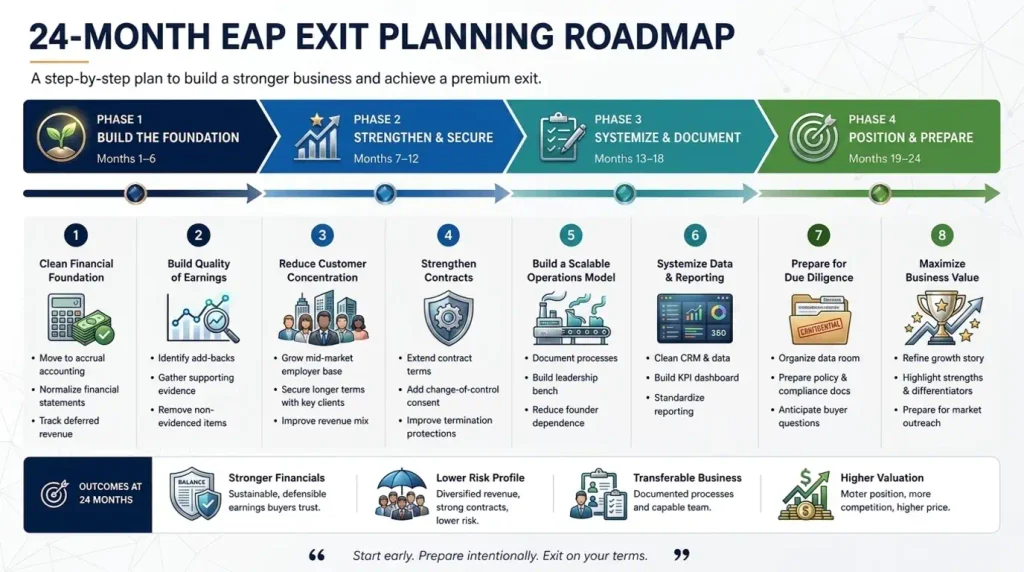
The nine EAP exit planning moves, in order of impact
1. Move to accrual accounting and clean the ledger
Every EAP exit planning exercise starts here, because every other number depends on it.
If you’re on cash basis, this is move one and there is no move zero.
EAP revenue is contracted annually and often invoiced quarterly or monthly in advance. On cash basis, your monthly earnings jump around for billing reasons that have nothing to do with the business. A buyer’s quality-of-earnings provider will restate all of it, and the restatement will happen during exclusivity, when you have no leverage and every surprise costs you something.
Do it now, and do it retrospectively for three years if your accountant can. Track deferred revenue properly while you’re in there — it comes back later in the working capital negotiation, and owners who’ve never looked at it lose real money at completion.
2. Build the add-back schedule with the evidence attached
Open the general ledger. Tag every expense you intend to claim as an add-back. Put the supporting invoice next to it.
Then — and this is the part nobody wants to do — delete anything you can’t evidence.
A smaller, fully supported adjusted EBITDA is worth more than a bigger one with three soft lines in it, because one rejected add-back makes every other number you’ve presented suspect. Credibility in diligence is a single asset. You spend it once. The valuation pillar goes through which add-backs typically survive and which get thrown out.
3. Attack customer concentration
This is the move that decides whether your EAP exit planning had two years to work in or four months.
Calculate your largest client and top-five client revenue share for each of the last three years. Note the direction of travel, because buyers care about the trend as much as the level.
If one employer dominates, you have two levers and both are slow:
- Grow the rest of the book. Mid-market employer wins dilute the share. This is ordinary business development with a specific target attached.
- Lock the big one down. Get the longest term you can at the next renewal, ideally with an escalator. A dominant client on a four-year agreement is a materially different risk from the same client on a rolling annual.
Left alone, concentration doesn’t stop a deal. It reshapes one — the concentrated revenue tends to get pushed into an earnout tied to that specific renewal, which means you get paid later and only if things go well. Pillar 4 covers that mechanism.
4. Extend contract terms at every renewal
Start now, because you only get one pass per client per year. Nothing else in EAP exit planning is this dependent on the calendar.
You are looking for: longer term, automatic renewal, an annual escalator, and softer termination-for-convenience language. You will not get all four from everyone. You will get some from most, because employers who are happy with the service generally don’t mind committing to it.
While you’re in each agreement, read the change-of-control and assignment language and write it down in a matrix. That single document — every contract, its term, its renewal mechanic, its consent requirements — is one of the most useful things a prepared EAP seller owns, and it takes an afternoon per twenty contracts.
5. Get your renewal rate out of your head and into records
Almost every owner can tell you their retention is strong. Very few can prove it.
Build the number from contract records: renewals by year, by employer size band, going back at least three years, with losses identified and the reason noted where you know it. Not memory. Records.
What you can’t evidence, a buyer assumes conservatively. That single sentence explains most of what EAP exit planning is for. This is the highest-return weekend of work in the whole exercise, and it costs nothing but a spreadsheet and a filing cabinet.
6. Build the clinician bench
Founder dependency has a sector-specific twin in this business: key-clinician dependency.
If a handful of affiliates carry most of your case volume, or one clinical lead holds the network together personally, a buyer will find it and price it. What they want to see is depth — a rostered network by specialty, licensure coverage mapped by state, credentialing files current, and some sense of how long it takes you to bring a new affiliate on.
Good EAP exit planning treats the network roster as a diligence asset rather than an operational necessity. Build it as a document, keep it current, and note the gaps yourself before someone else does.
7. Get yourself out of the renewal conversations
Write down what stops working if you don’t come in tomorrow. If the honest answer includes the top three renewals, that’s the item to work on, and it will take longer than you think.
This is the slowest item on the list and the one owners defer longest, which is why EAP exit planning has to start before the decision to sell does.
Hand relationships over while you’re still there to catch anything that drops. Introduce the account director on a call you’re on. Then a call you’re not on. Then stop going. Clients who’ve known you since 2011 will grumble, and most of them will be fine within two renewal cycles.
Owners who start this two years out arrive at a process with a management team. Owners who start at six months arrive with an org chart and a hope.
8. Assemble the compliance and credentialing file
Before anyone asks. Licensure and coverage by jurisdiction, confidentiality and data-privacy policies, incident logs, insurance certificates, any accreditation held, and your position on employee data handling — including cross-border transfer if you serve multinational employers.
In a sector built on confidentiality, an organized compliance file reads as competence and shortens diligence measurably. A disorganized one invites questions that expand into other questions. It’s not a valuation driver on its own, but it’s a friction remover, and friction in diligence gets converted into price.
9. Be honest about the technology story
Case management platform, employer reporting, digital front door, integrations. Buyers read technology as operating leverage: can this business add employer contracts without adding proportional headcount?
You do not need to build a platform in two years. You need to know what you have, be able to describe it accurately, and either fix the worst gap or be ready to explain why it doesn’t matter for the book you serve. Overselling your tech in a management meeting is a bad idea, because the technical diligence workstream will find out in week two of EAP due diligence, and everything else you said gets re-examined.
Who actually does this work
A fair question, since most EAP owners reading a nine-item list are already mentally adding it to a week that has no room in it.
Moves 1 and 2 belong to your accountant. Accrual conversion and the add-back schedule are bookkeeping tasks with a transaction purpose. Any competent accountant can do them; what they need from you is the instruction and the context. Tell them plainly that you may sell in two to three years and want the books to survive a quality-of-earnings review. That sentence changes how they approach it.
Moves 3, 4 and 7 belong to you. Concentration, contract terms and relationship handover are commercial decisions nobody can make on your behalf. They’re also the ones that generate the most value, which is inconvenient but true. Budget an hour a week rather than a project.
Moves 5, 6 and 8 belong to your operations lead. Renewal records, network roster, licensure mapping, compliance file. This is assembly work, not judgment work, and it delegates well. Most EAP exit planning stalls here because nobody was actually asked to own it. Ask someone.
Move 9 is a conversation, not a project. You need an honest description of your technology, not a new platform.
One practical note on confidentiality. You can do all nine without telling anyone you’re considering a sale, because every one of them is defensible as ordinary good management. “I want our renewal data properly documented” is a normal thing for an owner to say. Nobody will infer a transaction from it. EAP exit planning done quietly over two years looks, from inside the business, like a company tightening up.
The one place to be careful is a sell-side quality of earnings review, which is harder to explain internally. That belongs in the last six months, and by then a small circle usually knows anyway.
What an EAP exit planning timeline looks like
| When | Focus |
|---|---|
| 24–18 months out | Accrual conversion, three-year ledger cleanup, contract matrix built, concentration measured and a growth target set |
| 18–12 months out | Renewal cycle one: extend terms, add escalators, tighten change-of-control language where possible. Begin handing over relationships. |
| 12–6 months out | Add-back schedule with evidence. Renewal rate documented. Network roster and licensure mapping complete. Compliance file assembled. |
| 6–3 months out | Renewal cycle two on remaining contracts. Sell-side quality of earnings if scale warrants it. Sequence any large renewal ahead of a process rather than into it. |
| 3–0 months out | Data room built. Materials prepared. Nothing structural left to fix — by design. |
Illustrative planning framework — not transaction guidance.
The point of that table is the last row. If you arrive at a process with structural work still outstanding, you’ll be doing it under observation, on someone else’s clock, while running the company. That’s how good businesses produce disappointing outcomes.
What EAP exit planning is not
It isn’t a decision to sell. Every move on this list makes the business better to own, and you’re the current owner. Cleaner books, longer contracts, less concentration, a real management team — that’s a description of a business you’d enjoy running for another decade.
It isn’t a process you have to hire someone to start. The first five moves are you, your accountant, and your contract file. Nobody needs to be engaged for any of it.
It isn’t succession planning, though it overlaps. If your intended exit is handing the business to a partner or a family member rather than selling to a third party, most of this list still applies — you’re still transferring a business out of your head. The financial mechanics differ, but the transferability work is identical.
And it isn’t irreversible. Two years from now you may decide to keep going. You’ll do that with a stronger, more valuable, less founder-dependent company, which is a good outcome by any measure.
If a sale is genuinely on the horizon, the full guide to selling an EAP business sets out what happens after preparation ends. Owners who want their EAP exit planning stress-tested against live transaction activity before committing to anything will find that specialist sell-side firms including Olympic M&A have those conversations years ahead of a process, at no cost and with no obligation attached.
Start with the ledger. Everything else gets easier once the numbers are honest.
Frequently asked questions
What is EAP exit planning?
EAP exit planning is the process of making an employee assistance program business transferable to a new owner. It covers financial cleanup, contract term extension, reducing client concentration, documenting renewal history, building clinician bench depth and removing founder dependency, typically over a twelve to twenty-four month horizon.
When should I start EAP exit planning?
Twenty-four months before you intend to go to market. Contract terms change only at renewal and client concentration dilutes only through growth, so the two highest-impact moves both run on annual cycles. Planning begun inside six months is triage rather than preparation.
How do I prepare my EAP company for sale?
Move to accrual accounting, build an evidenced add-back schedule, measure and reduce client concentration, extend contract terms at renewal, document renewal rate from contract records, build clinician bench depth, transfer relationships away from yourself, assemble the compliance file and describe your technology honestly.
Does exit planning commit me to selling?
No. Every element makes the business more valuable and less dependent on the owner, which benefits you whether you sell or continue operating. Owners frequently begin exit planning while undecided, and some conclude they would rather keep running a business that has become easier to run.
What is customer concentration risk in an EAP?
Customer concentration risk is the exposure created when a large share of revenue sits with one employer client. Buyers price it directly, commonly by moving the concentrated revenue into an earnout tied to that contract renewing, meaning the seller receives that portion later and conditionally.
Is exit planning the same as succession planning for EAP owners?
They overlap substantially. Both require transferring knowledge, relationships and authority out of the founder. Succession planning to a partner or family member differs mainly in the financial and tax mechanics, while the operational transferability work is essentially the same list.